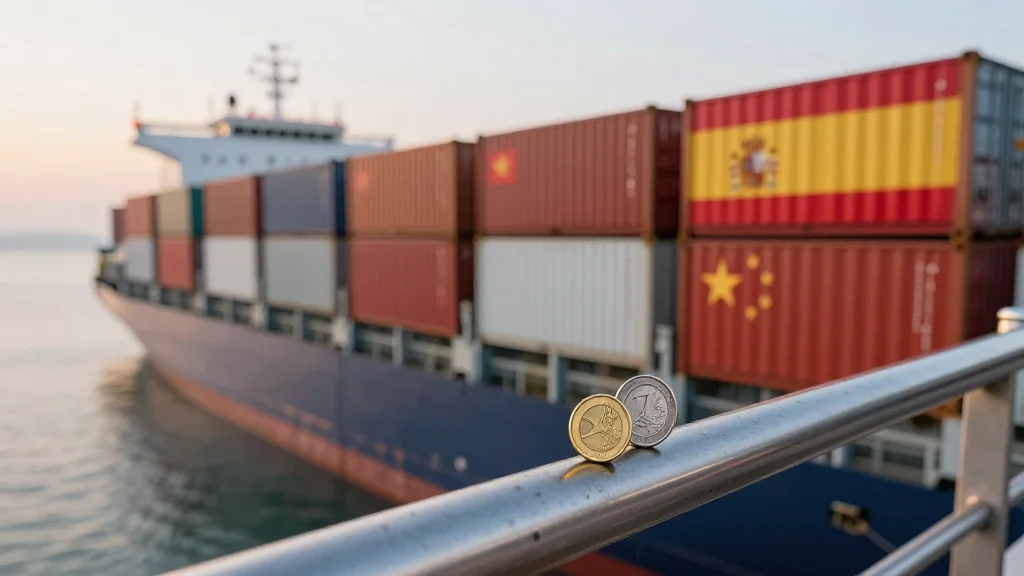
Spain’s “Compliment Sandwich” Aims to Bridge $50 B Trade Gap with China

Why It Matters
Spain’s $50 billion trade deficit with China is a microcosm of Europe’s broader economic exposure to Beijing. Reducing that gap could improve the EU’s balance of payments, lower inflationary pressures from imported goods, and lessen reliance on volatile energy supplies linked to Middle‑East conflicts. Moreover, the diplomatic model Sánchez is testing may provide a template for other European capitals seeking to protect economic interests without fully aligning with U.S. geopolitical agendas. The stakes are amplified by the concurrent U.S.–Iran war, which has already driven oil prices above $100 a barrel and disrupted shipping lanes. A stable Europe‑China trade relationship could act as a stabilizing force, offering alternative supply routes and markets that mitigate the shockwaves from Middle‑East volatility.
Key Takeaways
- •Spain’s trade deficit with China stands at nearly $50 billion, 74 % of its total external deficit.
- •Exports to China rose 6 % YoY, while imports jumped 11 % in the same period.
- •Prime Minister Pedro Sánchez used a “compliment sandwich” diplomatic style, praising China while demanding market reforms.
- •Analysts such as Wang Hanyi see the approach as a potential EU blueprint, but Philippe Le Corre and Bonnie Glaser remain skeptical.
- •The strategy unfolds amid a U.S.–Iran war that has spiked oil prices and heightened global economic uncertainty.
Pulse Analysis
Sánchez’s diplomatic gambit reflects a pragmatic shift in European foreign policy: leveraging soft power to extract economic concessions while sidestepping direct confrontation with the United States. Historically, Europe has oscillated between hard‑line criticism of China’s trade practices and reluctant engagement driven by market realities. The “compliment sandwich” attempts to break that binary by embedding criticism within a framework of mutual respect, hoping to coax Beijing into incremental reforms without triggering retaliatory trade measures.
If successful, the model could catalyze a more coordinated EU stance, allowing member states to present a united front that balances economic imperatives with geopolitical caution. However, the approach’s efficacy hinges on China’s perception of Europe’s strategic value. Beijing may view a fragmented EU as a weak negotiating partner, reducing the leverage of any single country’s overtures. Moreover, the ongoing U.S.–Iran conflict adds a layer of complexity: heightened energy prices and supply‑chain disruptions could force European economies to prioritize immediate stability over long‑term strategic diversification.
In the short term, Spain’s proposed Trade Cooperation Framework could deliver modest gains—lower tariffs on agricultural products, streamlined customs for tech components, and joint R&D initiatives. Over the longer horizon, the real test will be whether other EU capitals adopt Sánchez’s nuanced rhetoric or revert to more confrontational tactics. The outcome will shape not only the EU’s trade balance with China but also its ability to navigate a world where great‑power rivalries increasingly dictate economic outcomes.
Spain’s “Compliment Sandwich” Aims to Bridge $50 B Trade Gap with China
Comments
Want to join the conversation?
Loading comments...