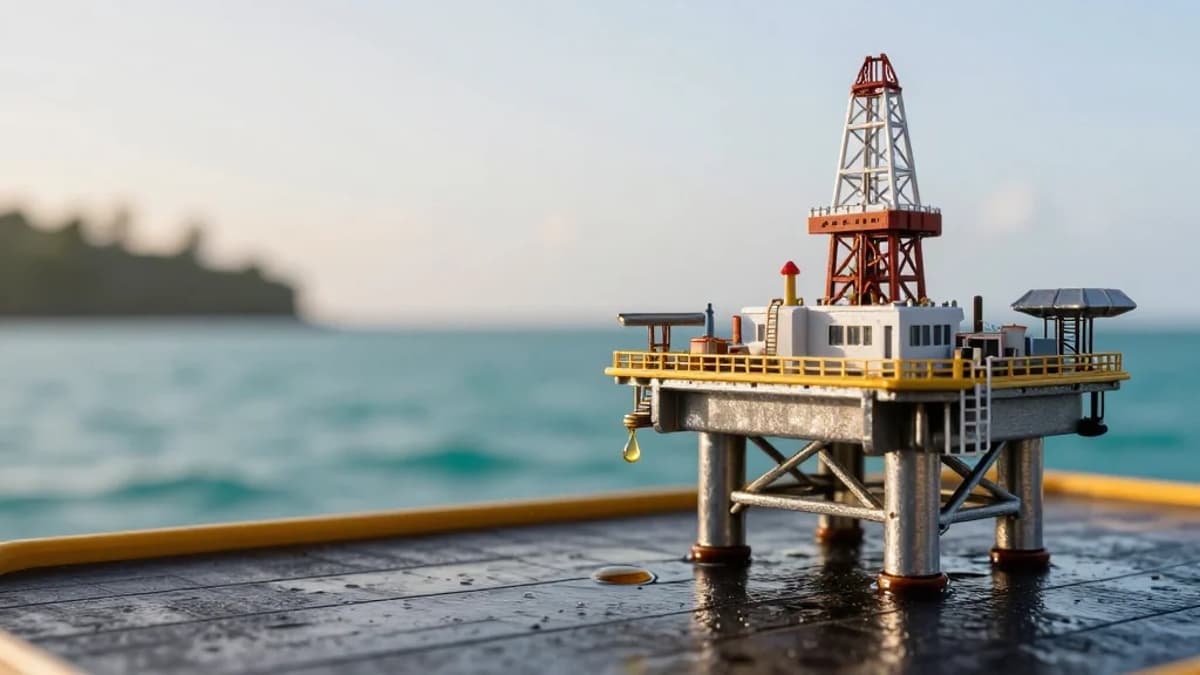
The project could reshape Suriname’s fiscal outlook, but mounting debt and governance risks threaten to dilute the promised economic boost, affecting investors and regional energy dynamics.
Suriname’s offshore Block 58 has emerged as the newest frontier in the Caribbean‑South American oil surge, with TotalEnergies and APA’s GranMorgu project promising 760 million barrels of light, sweet crude. The development’s low‑emission design—less than 16 kg CO₂ per barrel—positions it as a benchmark for environmentally conscious extraction, while its 220,000‑barrel‑per‑day capacity could rival early‑stage Guyana fields if brought online on schedule.
Yet the fiscal backdrop is stark. Gross public debt now tops 106 % of GDP and inflation has climbed to 13 %, prompting the IMF to flag fiscal and monetary slippages and downgrade growth expectations to 3.7 % for 2026. Governance challenges, lingering corruption scandals, and a history of ineffective reforms raise concerns about the country’s ability to capture and manage the anticipated oil revenues, especially given the eight‑year lead time before GranMorgu’s first oil.
For investors and policymakers, Suriname represents both a high‑reward opportunity and a cautionary tale. The sizable revenue potential could fund debt reduction and infrastructure upgrades, but only if transparent institutions and prudent fiscal policies are instituted. Regional analysts will watch how Suriname balances its oil ambitions with macro‑economic stability, a dynamic that could influence future investment flows across the nascent South American offshore oil corridor.
By Matthew Smith · Feb 16, 2026, 4:00 PM CST
The GranMorgu petroleum project in offshore Block 58, led by TotalEnergies and APA Corporation, is expected to deliver a significant economic windfall for Suriname, potentially generating $26 billion in revenue.
Suriname’s oil boom, however, is at risk because of severe economic instability: gross public debt stands at 106 % of GDP, inflation has surged to double‑digit levels, and the International Monetary Fund (IMF) has warned of fiscal and monetary slippages. The GranMorgu project, which is developing an estimated 760 million barrels of light, sweet crude, is a world‑leading low‑emission operation but is not expected to be commissioned until 2028, roughly twice as long as the timeline for neighboring Guyana.
A slew of high‑quality oil discoveries in offshore Block 58 by TotalEnergies and its 50 % partner APA Corporation has put the tiny South American country on the map as a potential “next Guyana.” Yet the offshore boom is fraught with delays. Conflicting geological data, high gas‑to‑oil ratios, poor drilling results and broader economic headwinds are weighing heavily on Suriname’s prospects. There is no certainty that Suriname will ever enjoy the economic windfall that petroleum has delivered for neighboring Guyana.
In the latest news, the IMF— which in 2021 bailed Paramaribo out with a $572 million loan package—expressed concerns about Suriname’s economic stability. The Fund warned that “Fiscal and monetary slippages in 2025 have eroded earlier stabilisation gains.” The fiscal slippage was driven by excessive government spending and insufficient revenue, draining the country’s coffers. Gross public debt rose to 106 % of GDP during 2025 and inflation hit 13 % by the end of that year.
The IMF is worried that Suriname cannot weather further financial shocks after a tumultuous decade marked by crises. After a decade of endemic corruption, malfeasance and maladministration under former President Dési Bouterse—who was convicted of narcotics trafficking and murder—Suriname suffered a severe economic downturn, with GDP shrinking 3.4 % in 2015, 4.9 % in 2016, and a steep 16 % drop in 2020 as the COVID‑19 pandemic hit developing countries hard.
Suriname is among the world’s most heavily indebted countries. IMF data show gross government debt is nearly 83 % of GDP. While that figure is lower than many larger, more developed economies, it is especially worrying because Suriname’s small economy has stagnated over the last decade. Even IMF‑mandated neoliberal reforms—such as reining in fiscal spending, substantially devaluing the Suriname dollar and ending costly energy subsidies—failed to spark a major recovery, weighing heavily on the economy and sharply impacting everyday people.
There are concerns about Paramaribo’s lack of preparedness to manage the massive influx of fiscal income from a major petroleum boom, with poor governance and corruption recurring themes in Suriname’s modern history. After a decade of economic stagnation, which sparked violent protests in 2021, the government is eager for the tremendous growth that petroleum production could deliver. While the IMF now forecasts 3.7 % GDP growth for 2026, that figure is only a sixth of the 23 % projected for neighboring Guyana, where rising oil production is driving rapid expansion.
In less than a decade, Guyana went from first oil to becoming the world’s seventh‑wealthiest country by GDP per capita (PPP). Suriname’s economic future hinges on offshore Block 58, where TotalEnergies is the operator and 50 % partner with Houston‑based APA Corporation. Since 2020, the drillers have made five major oil discoveries in the 1.4‑million‑acre block.
It is in offshore Block 58 that TotalEnergies is developing the GranMorgu petroleum project, located 93 miles offshore from Paramaribo. The $10.5 billion project is developing the Sapakara and Krabdagu discoveries, targeting a reservoir estimated to contain around 760 million barrels of crude oil. GranMorgu is slated for commissioning in 2028, meaning it will take Suriname roughly eight years—about double the four years it took Guyana’s Stabroek Block to go from first discovery to first oil. The facility will have a capacity to lift 220,000 barrels per day and is expected to generate $26 billion in revenue for Paramaribo over its operational life.
According to TotalEnergies, GranMorgu will be a world‑leading low‑emission crude‑oil operation, with carbon emissions of less than 16 kg of CO₂ per barrel lifted—well below the estimated global average.
Comments
Want to join the conversation?
Loading comments...