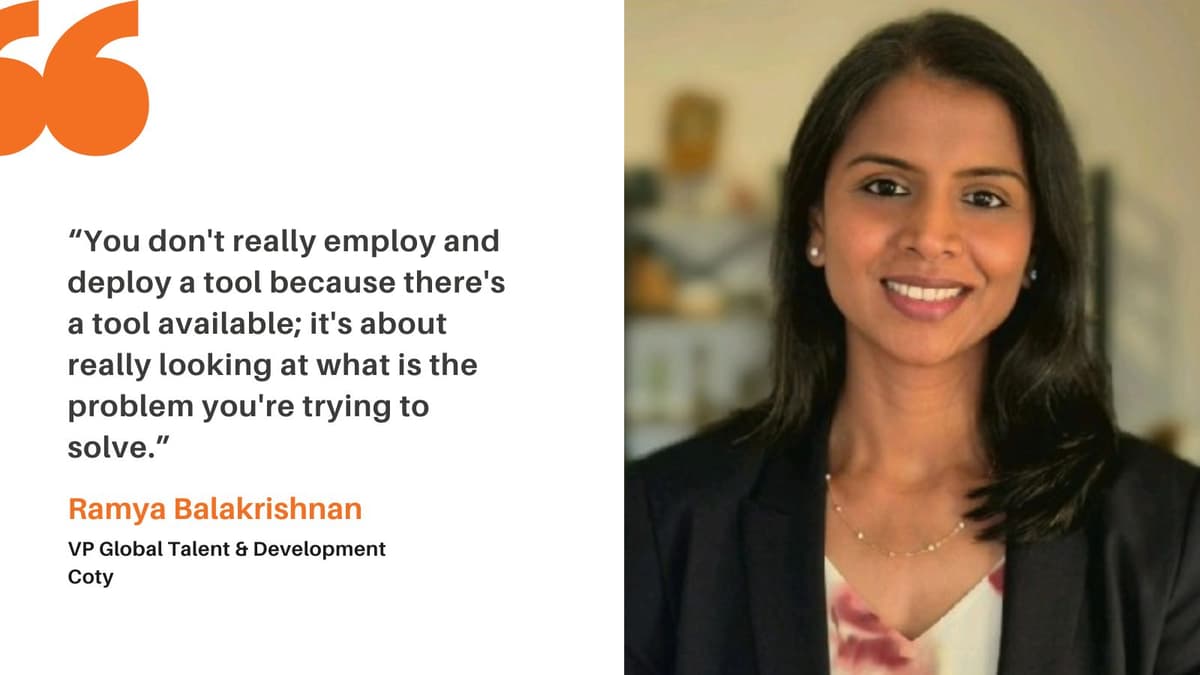
"AI Should Be Your Digital Sidekick": Coty’s Ramya Balakrishnan Shares How HR Can Build Practical AI Capability
Companies Mentioned

Coty
Why It Matters
The insight reframes HR’s AI journey as a strategic capability rather than a technology checklist, influencing how companies balance efficiency with long‑term talent development.
Key Takeaways
- •HR must prioritize judgement over tool selection
- •Coty targets 0.5 FTE gain per employee via AI
- •AI should solve employee friction, not replace processes
- •Avoid dangerous dependence and loss of learning opportunities
- •Hands‑on AI training drives practical capability in HR teams
Pulse Analysis
The rise of generative AI has turned HR departments into testing grounds for rapid digital transformation, yet many leaders still treat AI as a collection of tools rather than a strategic lever. Industry analysts note that the real competitive edge comes from the "judgement muscle"—the ability to interpret AI outputs, align them with business goals, and communicate implications to CEOs, CFOs, and line managers. By framing AI adoption around specific employee pain points, HR can avoid the trap of technology‑first thinking and instead drive purposeful work redesign that enhances productivity without eroding human insight.
Coty’s experiment illustrates a pragmatic path forward. Instead of launching costly vendor‑led programs, the company set a clear, measurable target: each of its roughly 150 HR staff should achieve the equivalent of half a full‑time employee’s output through AI assistance within a year. This "digital sidekick" model encourages employees to embed AI into daily routines—automating repetitive tasks, drafting communications, and surfacing data—while preserving time for higher‑value activities like talent strategy and employee experience. Hands‑on workshops replace lecture‑style training, fostering confidence through real‑world use cases and accelerating the feedback loop between technology and workforce.
For the broader market, Coty’s approach underscores two critical risks. First, over‑reliance on AI can create single points of failure if models falter, jeopardizing continuity. Second, excessive automation may starve employees of experiential learning, thinning the pipeline of future leaders. HR leaders should therefore audit each AI deployment against the three questions Balakrishnan posed—ease, dependence, and learning impact—to ensure sustainable adoption. As AI continues to reshape the workplace, the organizations that blend robust human judgement with targeted automation will capture the greatest long‑term value.
"AI should be your digital sidekick": Coty’s Ramya Balakrishnan shares how HR can build practical AI capability
Comments
Want to join the conversation?
Loading comments...