Your HR Tech Stack Is Being Rebuilt Around You. Do You Have a Voice in It?
Companies Mentioned
Why It Matters
The wave of platform‑level acquisitions and AI‑focused buyouts will redefine contract terms, data portability and strategic control for HR leaders, making early insight a competitive necessity.
Key Takeaways
- •HCM platforms acquired recruiting, talent, rewards, and AI tools in Q1 2026
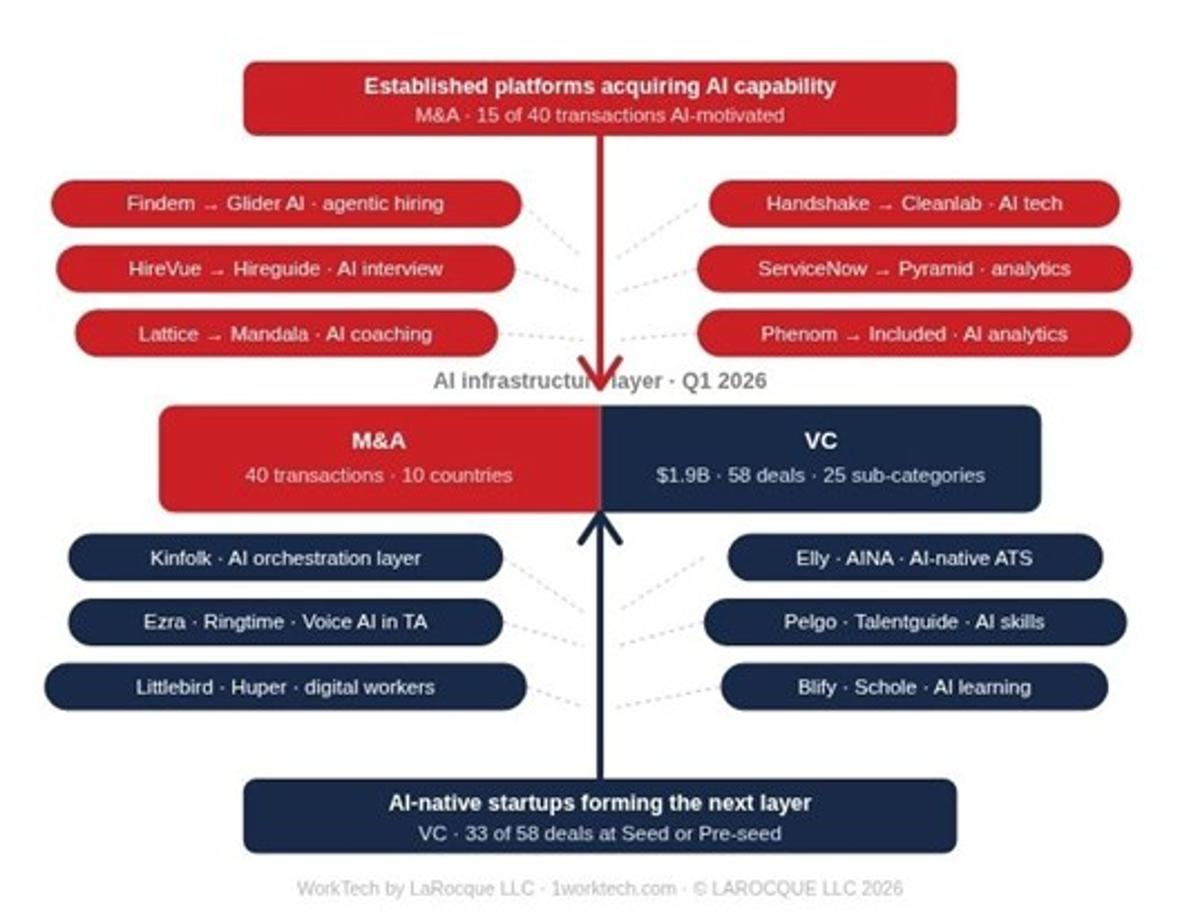
- •15 of 40 M&A deals cited AI capability as primary motive
- •Assessment, learning, benefits, and sourcing categories face active consolidation
- •CHROs must map vendors to acquisition risk for contract strategy
- •Track capital signals to anticipate AI features before product releases
Pulse Analysis
The HR technology market is undergoing a structural shift, driven by a concentration of capital in core HCM platforms. While $1.9 billion poured into work‑tech ventures this quarter, the real story is the pattern of cross‑category acquisitions—HCM vendors buying ATS, AI matching, and rewards solutions. This consolidation gives platform owners a decisive edge, allowing them to bundle disparate functions under a single roof and leverage economies of scale. For CHROs, the implication is clear: the modular stack they once curated is rapidly becoming a monolithic ecosystem controlled by a few dominant players.
Artificial intelligence is entering the HR stack not through incremental feature releases but via strategic buyouts. Fifteen of the forty tracked deals explicitly cited AI capability as the acquisition driver, ranging from foundational hiring engines to AI‑coaching modules. These technologies will surface in vendor platforms over the next 6‑12 months, often rebranded and embedded without a public roadmap. Consequently, HR leaders must shift their vendor conversations from product‑centric questions to acquisition‑centric inquiries—asking what capabilities are being purchased and how they will reshape existing contracts, data ownership, and integration pathways.
To navigate this accelerating consolidation, CHROs should adopt three practical tactics. First, map every solution in their current stack to its owner’s M&A activity, identifying which are acquirers, targets, or both. Second, monitor venture capital flows, especially the heavy funding into benefits and learning sub‑categories, to anticipate where innovation—and disruption—will arise. Third, treat AI as an acquisition strategy rather than a feature set, tracking announced deals to forecast upcoming functionality. By embedding market intelligence into their governance processes, HR executives can retain influence over technology choices and safeguard organizational agility amid the rapid re‑architecting of the HR tech landscape.
Your HR tech stack is being rebuilt around you. Do you have a voice in it?
Comments
Want to join the conversation?
Loading comments...