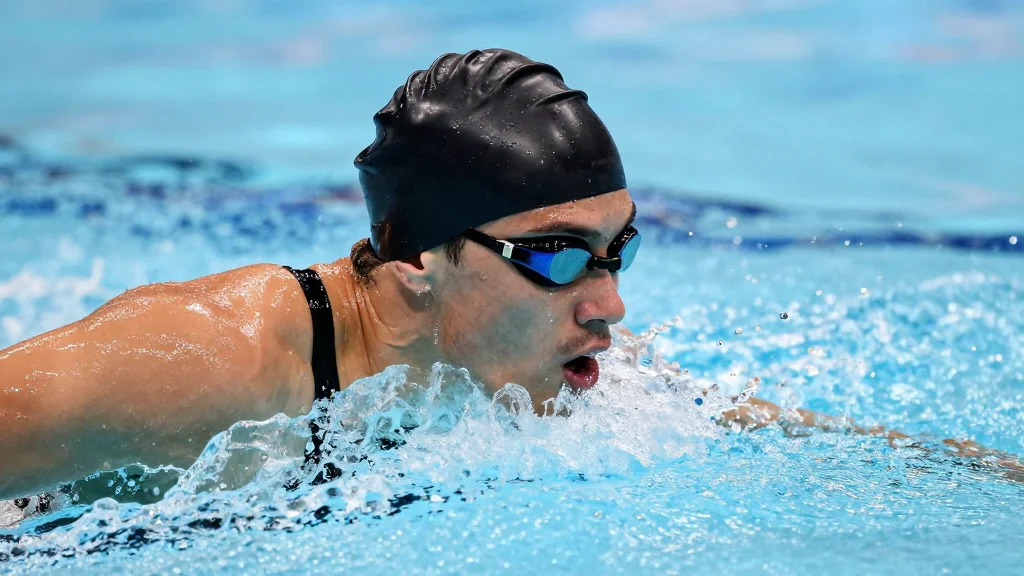
Cameron McEvoy Sets New 50m Freestyle World Record, Upending Traditional Training

Why It Matters
McEvoy’s record shatters the myth that sheer training volume is the sole driver of elite speed, suggesting that precision, recovery, and individualized data can yield superior outcomes. This challenges coaches across disciplines to reassess program design, potentially reducing injury rates and extending athletic careers. Moreover, the success underscores the broader human‑potential narrative: that scientific rigor and willingness to defy convention can expand the limits of what the human body can achieve. If adopted widely, the low‑volume, high‑intensity model could reshape talent development pipelines, funding allocations, and even the commercial market for performance‑tracking technologies. The ripple effect may accelerate a paradigm shift where data‑informed training becomes the default, redefining how peak performance is pursued in sport and beyond.
Key Takeaways
- •Cameron McEvoy swam 20.88 seconds for 50m freestyle, a new world record set in Shenzhen, March 2026.
- •Record achieved after cutting weekly training volume by ~40% and focusing on data‑driven intensity.
- •McEvoy’s shift challenges the long‑standing belief that higher volume guarantees faster times.
- •Australian Institute of Sport analyst Dr. Leah Tan cites research supporting individualized load management.
- •U.S. Swimming Federation earmarks $2 million for a Precision Training pilot inspired by McEvoy’s approach.
Pulse Analysis
McEvoy’s breakthrough arrives at a crossroads where sports science, wearable tech, and performance psychology intersect. Historically, swimming’s elite training has been defined by grueling mileage—think the 1990s “train till you drop” ethos that produced legends like Michael Phelps. Yet the last decade has seen a gradual infiltration of data analytics, from biomechanical video breakdowns to real‑time lactate monitoring. McEvoy’s success crystallizes this evolution, turning theory into a headline‑making result.
From a market perspective, the ripple effect could be profound. Companies that supply high‑resolution motion capture, AI coaching platforms, and recovery modalities stand to gain as athletes and federations scramble to emulate the low‑volume model. Expect a surge in venture capital targeting niche performance‑tech startups, mirroring the AI boom in enterprise software. Conversely, traditional coaching academies that cling to volume‑first curricula may see enrollment dip, prompting a strategic pivot toward hybrid curricula that blend science with experience.
Looking forward, the key question is scalability. McEvoy’s physics background gave him a unique ability to interpret data; replicating that insight across a broader athlete base will require democratizing analytics tools and upskilling coaches. If the sport can bridge that gap, we may witness a cascade of record‑breaking performances across distances, echoing the paradigm shift that saw the 2009 super‑suit era collapse under new regulations. In short, McEvoy’s 20.88‑second sprint is less a singular feat than a bellwether for a new era where precision trumps volume, and where human potential is re‑engineered through science.
Cameron McEvoy Sets New 50m Freestyle World Record, Upending Traditional Training
Comments
Want to join the conversation?
Loading comments...