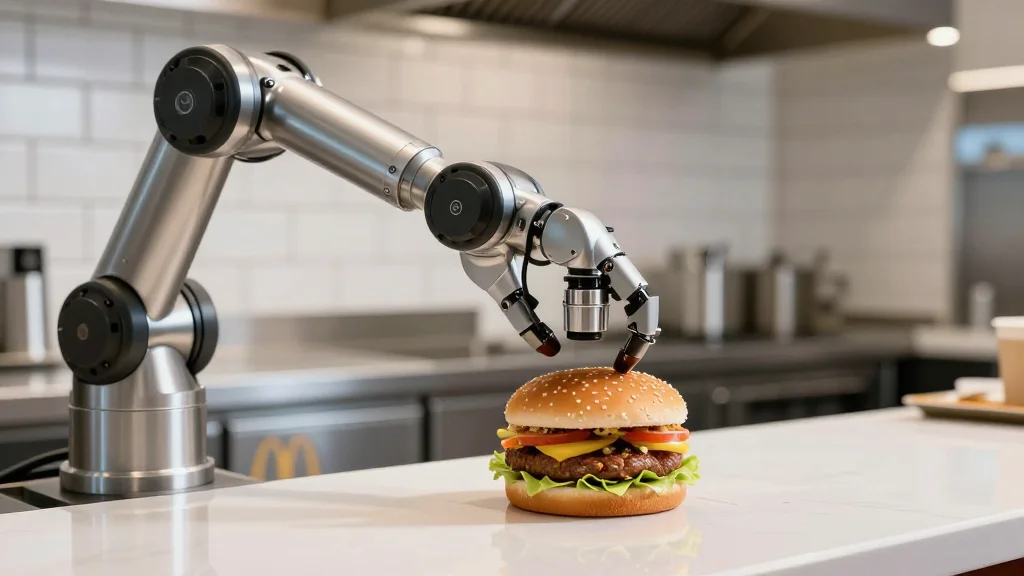
McDonald’s Rolls Out ‘NEXT’ Strategy to Simplify Franchises and Boost Automation

Companies Mentioned
Why It Matters
The NEXT strategy marks McDonald’s most ambitious attempt in a decade to re‑engineer its franchise model around automation and hospitality. By targeting unit economics, the chain seeks to protect margins in an environment of persistent inflation and shifting consumer expectations. Success could set a new benchmark for fast‑food operators worldwide, forcing competitors to accelerate their own technology investments. For franchisees, the plan introduces both opportunity and risk. Automation promises lower labor costs and more consistent product quality, but it also requires upfront capital and a cultural shift toward less human interaction. How quickly franchisees can adopt the new systems will influence the chain’s ability to regain lost market share among price‑sensitive diners and to stabilize its stock performance.
Key Takeaways
- •McDonald’s launches “McDonald’s > NEXT” to simplify franchise ops and boost automation.
- •CEO Chris Kempczinski says the plan will “unlock our next phase of growth and productivity.”
- •Value perception fell from 55% to ~40% among U.S. customers between 2020‑2024.
- •Shares dropped >1% on announcement and are down >9% YTD.
- •Rollout will begin with pilot markets, with a global expansion expected in 12‑18 months.
Pulse Analysis
McDonald’s NEXT initiative is a strategic pivot that reflects a broader industry shift toward technology‑driven efficiency. The fast‑food sector has long wrestled with thin margins, and automation offers a tangible lever to improve labor productivity without compromising speed—a core brand promise. However, the move also underscores a tension: as machines handle more tasks, the human element that differentiates a brand’s hospitality experience diminishes. Kempczinski’s acknowledgment that “fewer interactions” raise the hospitality bar suggests McDonald’s is betting on higher‑skill crew members to deliver a premium guest experience, a gamble that could strain franchisee labor budgets.
Historically, McDonald’s has used corporate strategy overhauls to reset growth trajectories—first with “Accelerating the Arches” in 2020, then now with NEXT. The latter’s focus on franchise‑level simplicity is a response to the franchisee backlash over recent cost pressures and the perceived erosion of value. By giving franchisees a clearer, technology‑enabled operating model, the company hopes to align incentives and restore confidence. Yet the lack of disclosed capital requirements leaves a question mark over the financial burden on franchisees, many of whom are already navigating rising commodity costs and tighter credit markets.
If NEXT can deliver measurable improvements in ticket size and labor cost ratios, it could re‑establish McDonald’s as the benchmark for operational efficiency in quick‑service restaurants. Competitors such as Burger King and Wendy’s are already experimenting with AI‑driven ordering kiosks and kitchen robotics; a successful NEXT rollout would force the entire sector to accelerate similar investments. Conversely, a sluggish adoption or failure to translate automation into consumer‑perceived value could deepen the brand’s value‑gap, further eroding its market share among price‑sensitive diners.
McDonald’s Rolls Out ‘NEXT’ Strategy to Simplify Franchises and Boost Automation
Comments
Want to join the conversation?
Loading comments...