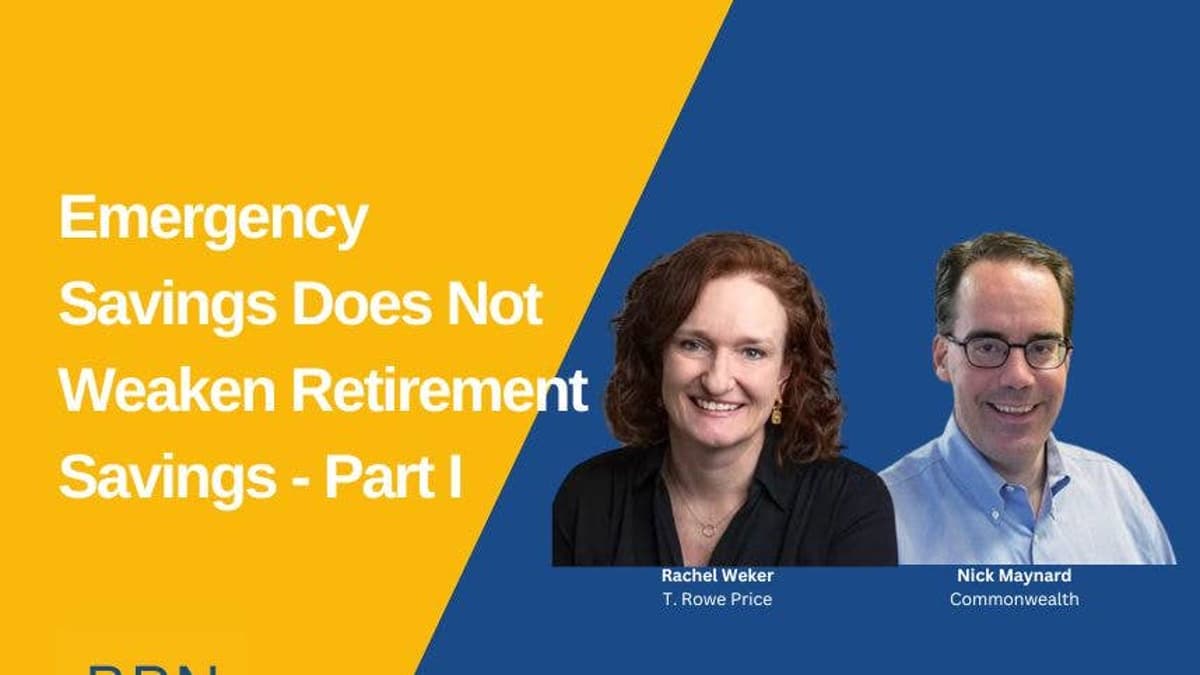
Emergency Savings Does Not Weaken Retirement Savings
Companies Mentioned
Why It Matters
Embedding emergency savings in retirement plans boosts participation, reduces costly loans, and aligns policy with real‑world financial‑wellness needs, strengthening overall retirement security.
Key Takeaways
- •Workers with emergency savings are 70% more likely to contribute to 401(k)
- •Participants with six‑month emergency funds take half as many plan loans
- •Secure 2.0 adds $1,000 penalty‑free withdrawal and PLESSA sidecar accounts
- •About 36% of sponsors have adopted the $1k emergency withdrawal provision
- •90% repay withdrawals, avg $943, within 2.5 months
Pulse Analysis
The rise of workplace emergency‑savings tools reflects a broader shift toward holistic financial wellness. Employers are recognizing that a modest liquidity buffer can dramatically improve 401(k) engagement, as data from Commonwealth and T. Rowe Price shows participants with six months of reserves are far more likely to stay invested and avoid costly hardship loans. By integrating a $1,000 penalty‑free withdrawal option and the newer PLESSA (Pension‑Linked Emergency Savings Account), plan sponsors can address short‑term cash needs without derailing long‑term retirement contributions.
Legislative momentum has accelerated this trend. The Secure 2.0 Act, passed in 2022, codified two mechanisms: a $1,000 emergency withdrawal that bypasses the 10% early‑distribution penalty, and PLESSA side‑car accounts that sit alongside traditional DC plans. Early adoption figures suggest roughly a third of sponsors have enabled the withdrawal feature, while newer proposals aim to raise the PLESSA cap to $5,000 and eliminate high‑compensation exclusions. These policy tweaks are designed to broaden access, especially for lower‑income workers who historically lack both emergency buffers and retirement savings.
From an employer perspective, the financial upside is tangible. Studies reveal that marketing the $1,000 withdrawal option can lift participation rates by up to nine points in non‑auto‑enroll environments, and more than 90% of employees who tap the fund repay it within an average of 2.5 months, preserving contribution momentum. As the industry refines user experiences—moving from paper forms to seamless digital portals—the psychological barrier of “locked‑up” money diminishes, encouraging broader enrollment and higher contribution levels. In sum, emergency‑savings integrations are proving to be a win‑win: they alleviate immediate financial stress while reinforcing the long‑term goal of a secure retirement.
Emergency Savings Does Not Weaken Retirement Savings
Comments
Want to join the conversation?
Loading comments...