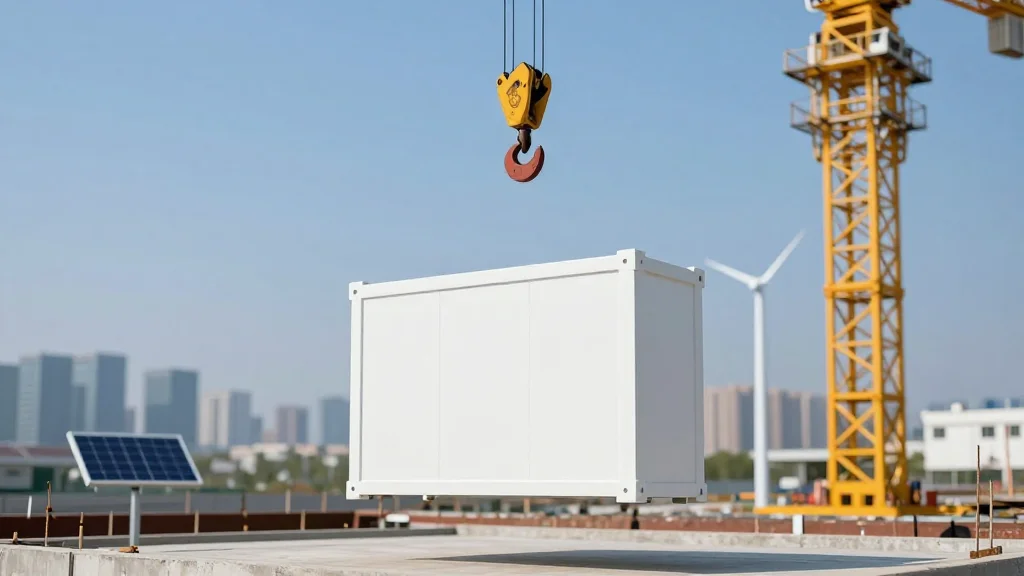
Chinese Modular and Holon Construction Exports Hit $4.3 B, Accelerating Global Build Times

Companies Mentioned
Why It Matters
The acceleration of modular and Holon construction reshapes how cities address housing shortages, infrastructure renewal, and climate goals. By delivering buildings in days and cutting emissions dramatically, the technology offers a tangible pathway to meet aggressive net‑zero targets while alleviating labor bottlenecks. For investors and developers, the shift signals a reallocation of capital toward factory‑based production, logistics platforms, and digital design tools. Companies that can integrate these capabilities stand to capture a larger slice of a market that is projected to exceed $10 bn in annual global sales within the next five years.
Key Takeaways
- •Exports of Chinese modular and Holon buildings rose to $4.3 bn in 2025, up from $1.5 bn in 2015.
- •Factory‑built structures can be assembled on site in days rather than months.
- •Carbon emissions from the prefabricated process are claimed to be up to 90% lower than traditional construction.
- •Lightweight steel B‑core slabs improve earthquake and typhoon resistance.
- •Analysts forecast a 15% YoY increase in global demand for modular construction in 2026.
Pulse Analysis
China's rapid scaling of modular construction reflects a broader convergence of digital manufacturing, logistics optimization, and sustainability imperatives. Historically, the construction sector has lagged in productivity gains; the modular surge represents perhaps the most significant efficiency leap since the introduction of prefabricated panels in the post‑war era. By centralizing production, Chinese firms achieve cost advantages that are difficult for fragmented Western contractors to match, especially as labor costs rise and skilled shortages deepen.
Geopolitically, the export of these technologies could become a soft‑power lever, allowing China to embed its standards in emerging markets while simultaneously opening new revenue streams. However, the model's success depends on regulatory acceptance and the ability to prove long‑term performance. If Western regulators impose stringent certification hurdles, Chinese firms may need to localize production or partner with domestic players, potentially diluting their cost edge.
Looking forward, the next inflection point will be the integration of advanced robotics and AI-driven quality control within the factory floor. Companies that can combine high‑speed assembly with real‑time data analytics will not only reduce cycle times further but also provide the transparency required for green‑building certifications. Investors should monitor which firms are securing patents in automated module fabrication and which are forging cross‑border joint ventures to navigate regulatory landscapes. The firms that master both the technical and political dimensions of modular construction are poised to dominate the next decade of global building activity.
Chinese Modular and Holon Construction Exports Hit $4.3 B, Accelerating Global Build Times
Comments
Want to join the conversation?
Loading comments...