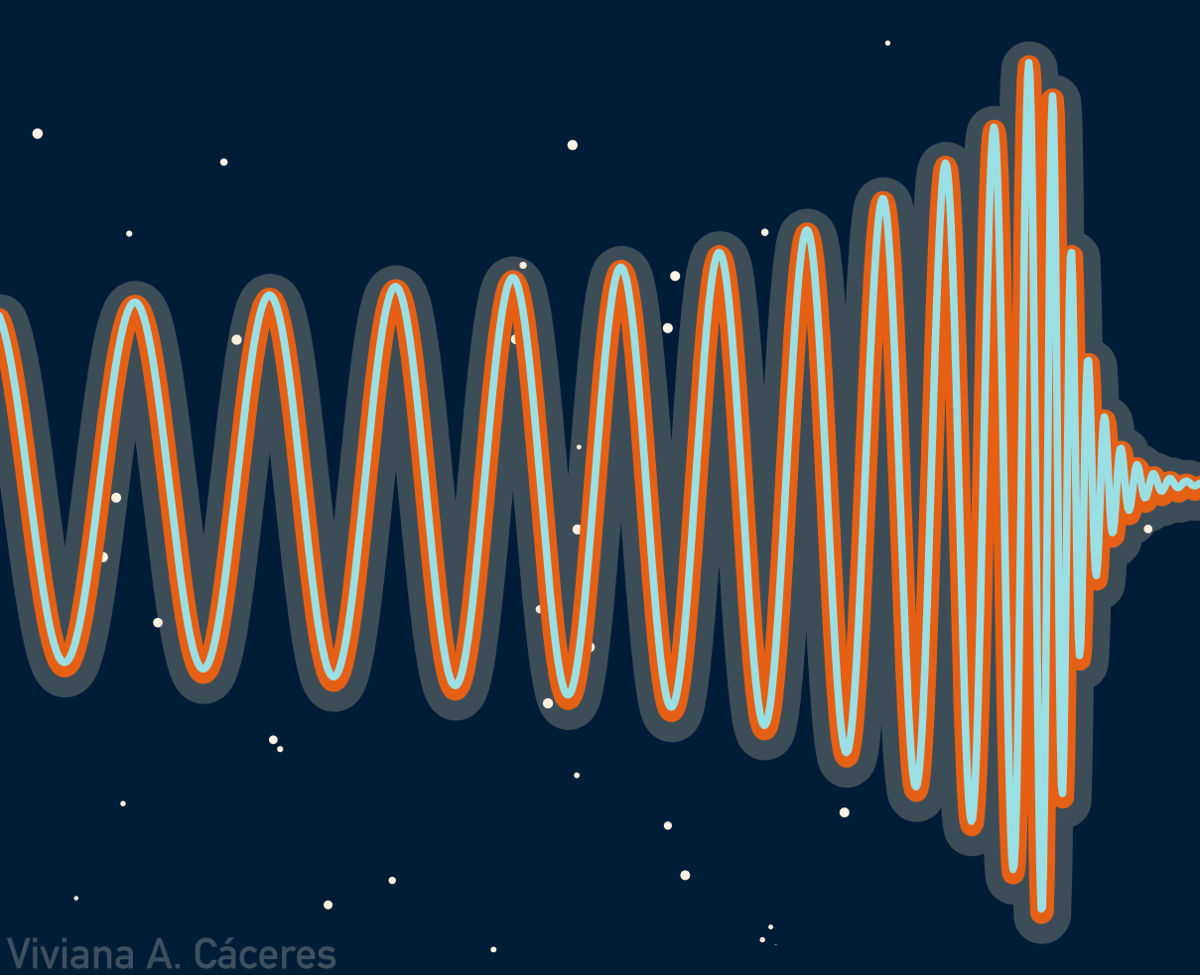
Uncertainty Is the only Certainty in Gravitational Waveforms
A new study introduces an uncertainty‑aware gravitational‑waveform model that samples the full range of waveforms consistent with numerical‑relativity fits. By propagating fit‑coefficient errors, the model prevents spurious deviations in parametrized post‑Einsteinian (ppE) tests, which otherwise appear when standard single‑waveform models are used. Simulated injections of 20‑ and 60‑solar‑mass binary black holes show a non‑zero ppE parameter β with conventional models, but a β distribution centered at zero with the uncertainty‑aware approach. The work highlights a hidden systematic that could mislead future high‑sensitivity observations.

The First Starspot Spectrum Revealed by JWST
Astronomers using JWST have captured the first panchromatic spectrum of a starspot on the fully convective M‑dwarf TOI‑3884. By observing six transits of its pole‑on planet, they isolated the spot’s contrast across 0.6‑5 µm wavelengths. The data match existing starspot models...

Flashy and Fashionably Late: The Fascinating Time Lag in Blazar Flares
A new study of roughly 100 blazars using Fermi‑LAT gamma‑ray data and long‑term radio observations from RATAN‑600 and MOJAVE finds that more than half exhibit a pronounced lag of 0.5 to 3.5 years between their gamma‑ray and radio flares. The authors...

Detecting Cold Gas in a Hot Supercluster
Researchers using the MeerKAT radio telescope have mapped neutral hydrogen (HI) in the core of the Shapley Supercluster, the most massive bound structure in the nearby universe. By cross‑matching HI detections with optical data, they confirmed 169 galaxies as bona‑fide...

Exoplanets in a Bottle: How Laboratory Experiments Help Us Understand Distant Planets
Laboratory experiments are becoming essential for interpreting exoplanet observations as telescopes like JWST and the upcoming ELT deliver detailed atmospheric spectra. Researchers use high‑temperature furnaces, pressure cells, and laser‑levitation setups to measure outgassing, gas solubility, and haze formation under planetary...
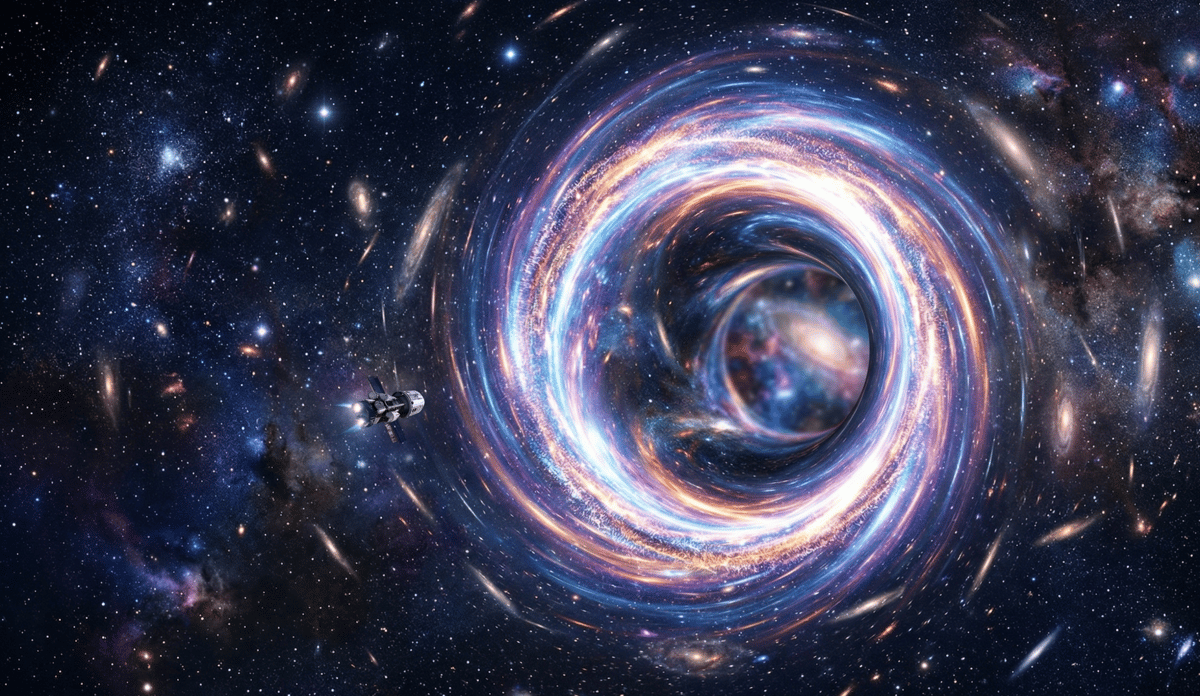
Wormholes Might Be More Real than We Thought
Physicists Leonel Bixano and Tonatiuh Matos have published an exact rotating wormhole solution to Einstein’s field equations that does not require exotic matter. By adding an electromagnetic field and a dilaton scalar field—features that appear in string theory, Kaluza‑Klein and...

Tell Me Why? A Case for Human(e) Astrophysics
Professor Matthew Schwartz demonstrated "Vibe Physics" by guiding Claude through a full theoretical physics calculation, producing a paper in two weeks after 110 drafts, tens of millions of tokens and 40 hours of compute. The experiment highlights that large language...

Too Massive, Too Early… and Still Not Massive Enough?
A new pre‑print using ultra‑deep JWST NIRSpec spectra of nine quiescent galaxies at z≈0.7 finds many exhibit bottom‑heavy initial mass functions. The authors quantify the IMF‑mismatch parameter α_IMF, which exceeds unity in most objects and scales with velocity dispersion and...

An Introduction to Obsidian for the Busy Astronomer
The article introduces Obsidian, a free, local‑first note‑taking app that stores research notes as plain‑text Markdown files. It emphasizes bidirectional linking and a Graph View that turn scattered files into a navigable knowledge network. The author highlights the ability to...

Looking Through the Eccentricity Pinhole
A new arXiv paper derives a universal eccentricity distribution for binary black holes formed through dynamical channels. By modeling the narrow “pinhole regime” where only specific trajectories retain measurable eccentricity, the authors find the distribution scales as e^{-31/19}, markedly steeper...

Feeding Time at the AGN Zoo
The paper links Fermi‑detected blazars and radio galaxies through their accretion and jet radiation mechanisms, analyzing 838 BL Lacs, 784 FSRQs, 55 LERGs and 17 HERGs. Gamma‑ray photon index versus luminosity separates BL Lacs from FSRQs and shows HERGs align with FSRQs...

A Wandering Supermassive Black Hole Eating a Star
Astronomers have identified AT2024tvd, a tidal disruption event occurring 0.8 kiloparsecs (≈2,600 light‑years) from the nucleus of a massive galaxy 600 million light‑years away. Multi‑wavelength observations from ZTF, Swift, Pan‑STARRS, and XMM‑Newton were modeled with the kerrSED accretion‑disk framework, revealing a black hole...