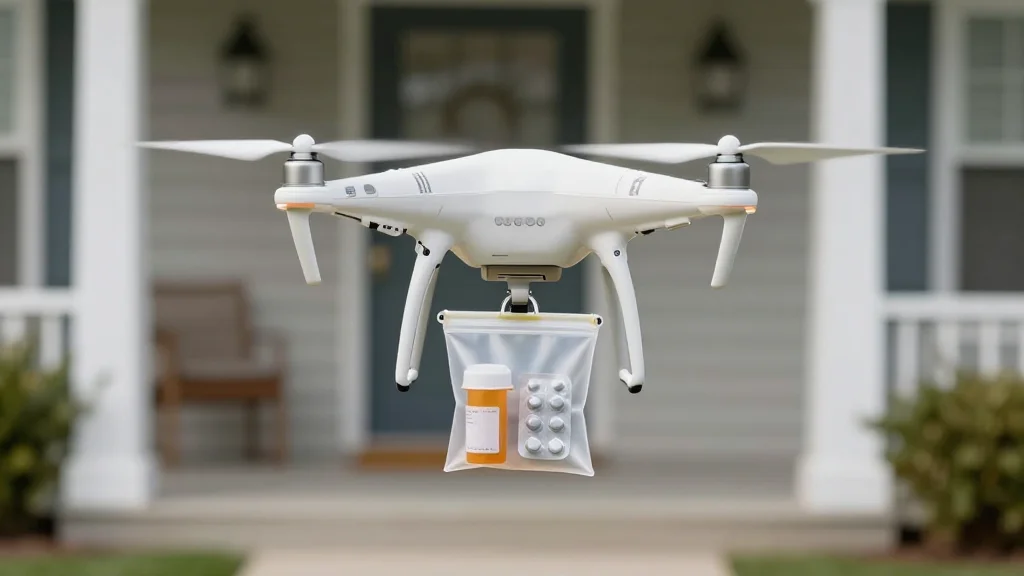
Pharmacy Deliveries Take Flight: Can Drones Solve America’s Pharmacy Access Gap?
Drone delivery of medications is moving from pilot testing to early operational use across the United States. Federal Aviation Administration Part 135 certification now permits beyond‑visual‑line‑of‑sight flights, enabling compensated, temperature‑controlled shipments to remote patients and health‑system hubs. Studies estimate between 15.8 million and 57.1 million Americans live in pharmacy deserts, and pilot projects in Virginia, Maryland, Ohio and Texas demonstrate delivery times under 60 minutes at roughly $1 per drop. The emerging regulatory framework and cost advantages suggest drones could narrow the pharmacy access gap, especially in rural and disaster‑prone areas.
AAN 2026: Long Half-Life and Long-Acting Injectable, What Pharmacists Should Know About RAP-219's Dosing Advantages for Focal Epilepsy
Rapport Therapeutics presented phase 2 data for RAP‑219 at the AAN 2026 meeting, showing 24% of drug‑resistant focal epilepsy patients achieved complete seizure freedom over an eight‑week period. The trial leveraged responsive neurostimulation (RNS) devices to capture objective electrographic seizure data,...
Collaborative Care Is Redefining Survival in Multiple Myeloma
Collaborative, multidisciplinary care is reshaping multiple myeloma treatment, linking hematology, transplant, pharmacy, infectious disease, and supportive services across the disease continuum. The non‑linear therapy pathway—spanning induction, autologous stem‑cell transplant, maintenance, CAR‑T and bispecific antibodies—requires constant cross‑specialty communication to avoid delays...

As Peptides Go Mainstream, USP and Matter More Than Ever
Peptide therapies have moved from niche compounding to mainstream outpatient care, driven by telehealth platforms and rapid market growth. This expansion has attracted regulatory attention, with state boards and courts increasingly referencing USP and as compliance benchmarks. Non‑sterile peptide...

Recapping AAAAI 2026: Updates on Remibrutinib and Innovative Treatments for Food Allergy, Atopic Disease, Asthma
At AAAAI 2026, Novartis presented data confirming remibrutinib’s rapid and sustained efficacy in chronic spontaneous urticaria, with a 25 mg BID dose delivering significant UAS7 reductions. Phase 2 trials also demonstrated the BTK inhibitor’s potential in peanut allergy, achieving 86.7% tolerance at...
The Oncology Pharmacist Advocacy Toolkit: Real-World Scripts, Hill Day Strategies, and Policy Insights
LeAnne Kennedy highlights a new Oncology Pharmacist Advocacy Toolkit that equips pharmacists with practical scripts, elevator pitches, and virtual Hill Day strategies to influence policy and patient care. She stresses the need for clear communication of the oncology pharmacist role...
The Right Drug for the Right Resident: 5 Practical Strategies for Long-Term Care Pharmacies to Improve Outcomes
The APEX Live panel outlined five practical strategies for long‑term care (LTC) pharmacies to improve resident outcomes. Structured medication regimen reviews (MRR/MMR) should trigger repeatable recommendation workflows that address high‑risk drugs, functional status, and preventive gaps. Safer therapeutic defaults—beta‑3 agonists...

FDA Approves Navepegritide for Children With Achondroplasia
The FDA granted accelerated approval to navepegritide (Yuviwel), a once‑weekly CNP prodrug, for children aged two years and older with achondroplasia and open growth plates. In the phase 2b ApproaCH trial, the drug raised annualized growth velocity to 5.89 cm/year, a 1.49 cm/year...
Pharmacists Navigate an Evolving Immunotherapy Landscape in Advanced Non–Small Cell Lung Cancer
Oncology pharmacists are increasingly central to advanced non‑small cell lung cancer (NSCLC) care, overseeing treatment selection, biomarker testing, and patient education. Recent data show cemiplimab improves overall survival both as monotherapy in high PD‑L1 tumors and when combined with chemotherapy...
Advanced Approaches to Pediatric Fluid and Electrolyte Therapy: What Pharmacists Need to Know
The article outlines modern pediatric fluid and electrolyte therapy, emphasizing isotonic maintenance IV solutions to curb hyponatremia and detailing the Holliday‑Segar and BSA‑based calculation methods. It differentiates oral rehydration for mild‑to‑moderate dehydration from phased isotonic bolus and deficit‑plus‑maintenance IV regimens...

Evolving Frontline Treatment Strategies in Diffuse Large B-Cell Lymphoma
Frontline treatment of diffuse large B‑cell lymphoma (DLBCL) is shifting from traditional R‑CHOP toward targeted and bispecific antibody‑based regimens. The POLARIX phase‑3 trial demonstrated that Pola‑R‑CHP improves progression‑free survival, particularly in activated‑B‑cell (ABC) disease and older patients. Early phase studies...

Pembrolizumab-Induced Adrenal Insufficiency: Recognizing and Managing a Diagnostic Challenge in Adjuvant NSCLC Therapy
Pembrolizumab used as adjuvant therapy for NSCLC can cause central adrenal insufficiency, presenting with nonspecific fatigue, nausea, and hyponatremia. In a 67‑year‑old patient, a markedly low morning cortisol and suppressed ACTH confirmed the diagnosis within ten weeks of treatment. Prompt...

Cetirizine and Levocetirizine Withdrawal Pruritus: What Pharmacists Need to Know About the FDA’s New Safety Warning
The FDA will update labeling for cetirizine and levocetirizine to warn of a rare but serious withdrawal‑related pruritus that can emerge days after stopping long‑term use. More than 200 adverse‑event reports, primarily linked to cetirizine, describe severe itching requiring medical...
Insulin Affordability: Policies and Pharmacist Roles in Diabetes Management
Insulin’s list price has surged more than 300% over the past two decades, driven by a rebate‑heavy gross‑to‑net bubble and limited biosimilar competition. Pharmacy‑benefit managers (PBMs) dominate 79% of the market, using high‑list‑price rebates to secure formulary placement, which inflates...