
Quantum ‘Jamming’ Explores the Truly Fundamental Principles of Nature
Quantum jamming is a theoretical process that can subtly alter entangled particle correlations without violating the no‑signaling principle, challenging the monogamy of entanglement that underpins device‑independent quantum key distribution. The concept originated in a 1990s thought experiment by Grunhaus, Popescu and Rohrlich and has resurfaced in recent papers, including a December 2025 preprint by Ramanathan, Eckstein and collaborators. Researchers now view jamming as a probe for deeper causal principles that could replace or augment current quantum foundations. The debate has direct implications for the security of future post‑quantum cryptographic protocols.

The Ancient Weapons Active in Your Immune System Today
Researchers have uncovered that many bacterial antiviral defense mechanisms are conserved in human innate immunity, notably the cGAS‑STING pathway, which shares structural similarity with bacterial enzymes. Over the past decade, hundreds of new bacterial defense systems have been identified, and...

The AI Revolution in Math Has Arrived
In July 2025 AI models cracked five of six International Mathematical Olympiad problems, prompting mathematicians to experiment with the technology beyond puzzles. By early 2026, AI‑driven systems such as AlphaEvolve and the First Proof challenge were solving research‑level questions, often...

In Expanding De Sitter Space, Quantum Mechanics Gets Even More Elusive
Physicists are grappling with the paradoxes of quantum mechanics in an expanding de Sitter universe, where the lack of a fixed boundary prevents conventional measurements. Recent theoretical work suggests that photons could acquire an effective mass in this exponentially expanding space,...

Are Strings Still Our Best Hope for a Theory of Everything?
String theory, 58 years old, remains the leading candidate for a unified theory of everything despite ongoing criticism. New bootstrap approaches have derived the Veneziano amplitude from minimal assumptions, suggesting that string theory may be the unique UV‑complete description under...

The Math That Explains Why Bell Curves Are Everywhere
The central limit theorem (CLT) explains why bell‑shaped normal distributions appear in everything from rainfall measurements to SAT scores. Originating with Abraham de Moivre’s 18th‑century gambling calculations, the theorem was formalized by Pierre‑Simon Laplace and now underpins modern statistical inference. By...

Where Some See Strings, She Sees a Space-Time Made of Fractals
Physicist Astrid Eichhorn leads the asymptotic safety program, proposing that quantum‑gravity interactions become scale‑invariant at the Planck scale, yielding a fractal‑like space‑time. Her work shows that a fixed point persists even when all known matter fields are included, allowing the...
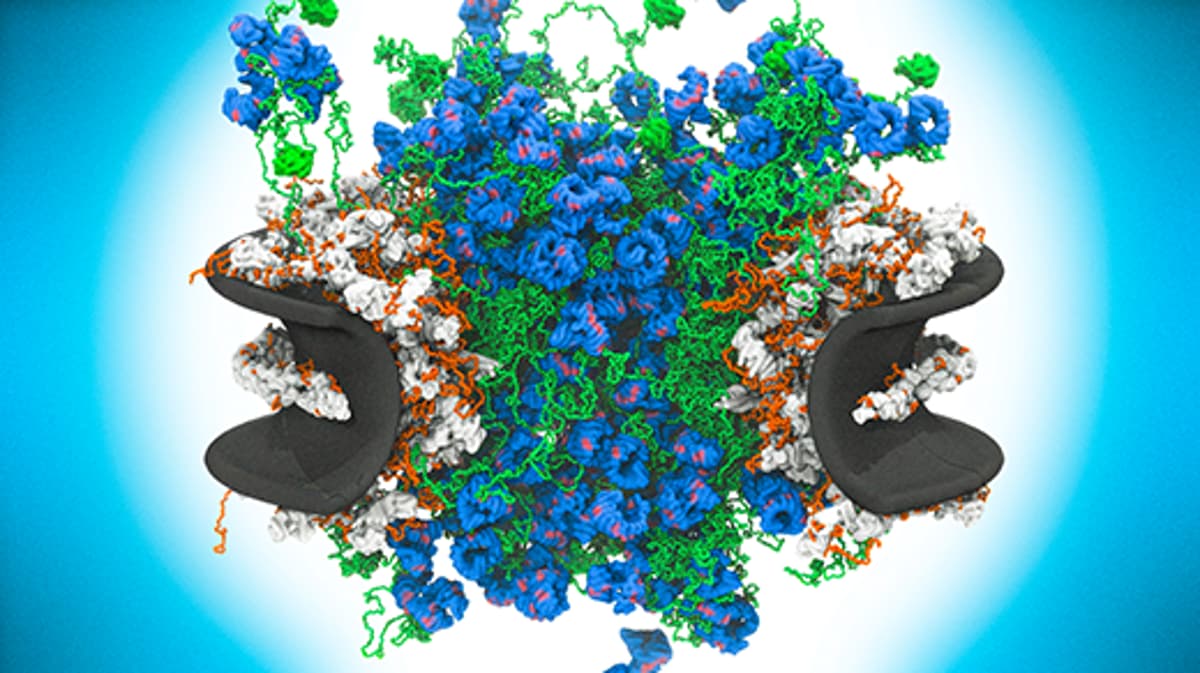
Disorder Drives One of Nature’s Most Complex Machines
A 2025 study using high‑speed atomic force microscopy visualized the nuclear pore complex’s central channel in millisecond detail, revealing a constantly shifting “central plug” made of karyopherin transport proteins and their cargo. The dynamic behavior supports a brush‑like “virtual gate”...

New Strides Made on Deceptively Simple ‘Lonely Runner’ Problem
Mathematicians have finally proved the lonely runner conjecture for eight, nine, and ten runners, marking the first major advance in decades. The breakthroughs stem from Matthieu Rosenfeld’s computer‑assisted approach, which built on Terence Tao’s finite‑speed reduction, and an undergraduate, Paul...