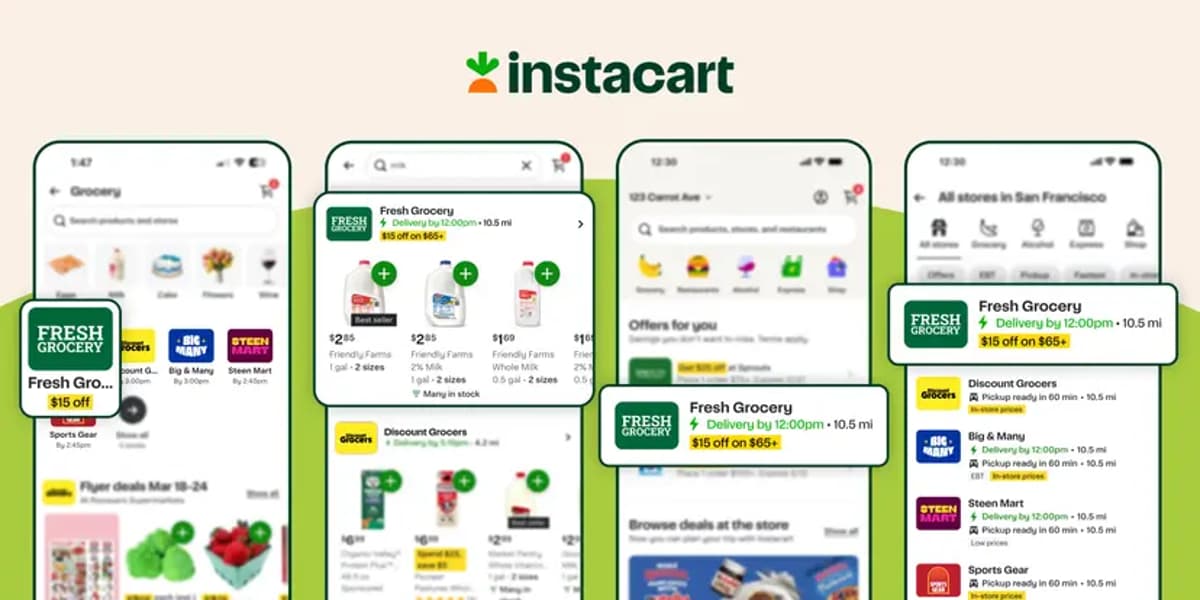
Instacart Expands Ads Manager Tools to Retailers
Companies Mentioned

Why It Matters
By giving retailers direct control over digital advertising on a high‑traffic grocery platform, Instacart unlocks new revenue streams and sharper shopper acquisition, accelerating the shift toward performance‑based marketing in the grocery sector.
Key Takeaways
- •Instacart Ads revenue topped $1 billion in 2025.
- •Retailers can now run self‑serve campaigns within Ads Manager.
- •Real‑time redemption and sales metrics enable instant optimization.
- •First‑party audience data can be activated on Meta and other channels.
- •Over 2,200 retail banners (≈100,000 stores) will access the tools.
Pulse Analysis
Instacart’s advertising business has surged to a $1 billion‑plus revenue stream, reflecting the growing appetite among consumer packaged goods (CPG) brands for data‑driven placements on grocery delivery platforms. As shoppers increasingly rely on digital channels for everyday essentials, the company’s ad infrastructure—built on first‑party shopper data and closed‑loop measurement—has become a valuable asset for brands seeking measurable ROI. Extending this infrastructure to retailers marks a strategic pivot, allowing the platform to capture a larger slice of the e‑commerce advertising pie.
The newly launched self‑serve tools give retailers granular control over promotions, from basket‑level discounts to audience segmentation based on purchase intent. Real‑time dashboards surface redemption rates, sales lift, and new‑to‑banner growth, enabling rapid A/B testing and budget reallocation without waiting for managed‑service intervention. Moreover, the partnership with Meta lets retailers push Instacart’s first‑party audiences to off‑platform media, re‑engaging lapsed shoppers and expanding reach beyond the marketplace. This integrated approach promises higher conversion efficiency and a clearer attribution model for retail marketers.
Industry analysts view Instacart’s expansion as a bellwether for the broader grocery sector, where retailers are increasingly adopting performance‑marketing models traditionally reserved for pure‑play e‑commerce. Competitors such as Amazon Fresh and Walmart’s advertising arm are also investing in in‑platform ad solutions, intensifying the race for shopper data ownership. As Instacart rolls out additional features—sponsored placements, discovery slots, and curated shopping events—retailers that leverage these tools early could gain a competitive edge in customer acquisition and basket size growth, reshaping the economics of online grocery retail.
Instacart expands Ads Manager tools to retailers
Comments
Want to join the conversation?
Loading comments...