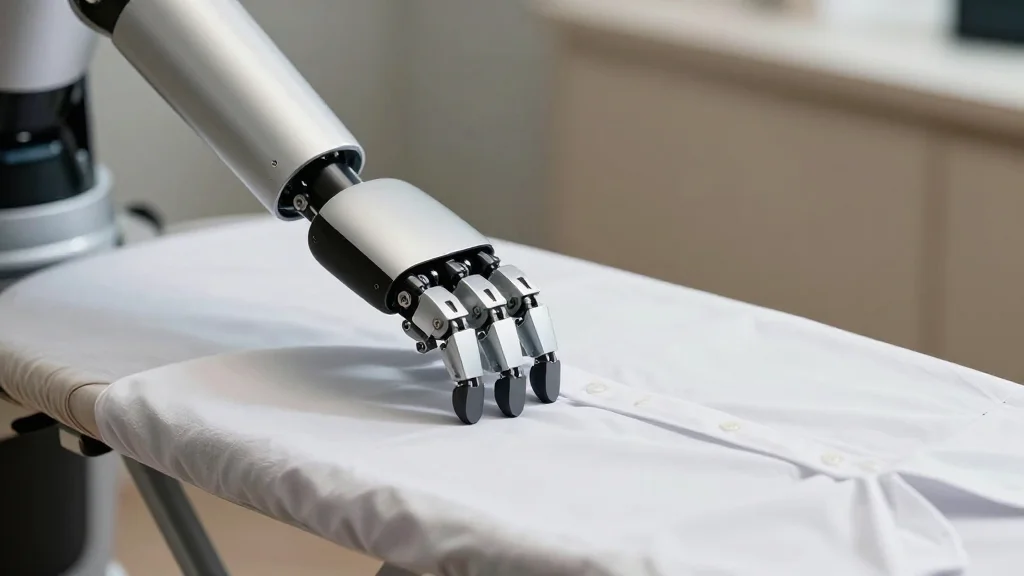
AI‑Powered Home Robots Target Laundry and Ironing, Experts Say

Companies Mentioned
Why It Matters
The emergence of AI‑driven domestic robots could redefine household labor, freeing up time for consumers and reshaping service‑industry employment. By moving AI out of the screen and into physical tasks, companies are creating new revenue streams and competitive advantages that could eclipse traditional appliance manufacturers. Moreover, the technology’s spillover effects—such as self‑optimizing factory robots and AI‑assisted surgery—highlight a broader trend where physical AI becomes a foundational layer across multiple sectors, accelerating automation and potentially reshaping supply chains worldwide.
Key Takeaways
- •Agile Robots opened a Palo Alto office to accelerate U.S. development of physical AI.
- •Physical Intelligence announced a robot that can fold laundry, iron, and make espresso after real‑world learning.
- •Jeff Bezos backs Project Prometheus and Physical Intelligence, aiming to commercialize household‑level robots.
- •Bob Nelsen highlighted the distinction between standard AI (text, images) and physical AI (real‑world tasks).
- •Industry analysts predict the domestic robotics market could grow beyond $10 billion within five years.
Pulse Analysis
The push toward household‑level physical AI reflects a convergence of three trends: advances in reinforcement learning, cheaper compute hardware, and a growing appetite for automation in everyday life. Early adopters like Agile Robots are betting that the cost of training a robot in a simulated environment will soon be offset by the value of labor saved at home. Historically, robot adoption has been limited to industrial settings where ROI is clear; this new wave seeks to replicate that ROI in the consumer sphere, where the value proposition is more nuanced—time saved, convenience, and lifestyle enhancement.
Competitive dynamics will soon center on data acquisition. Companies that can amass diverse, high‑quality interaction data—whether from pilot homes or factory floors—will train more robust models, creating a virtuous cycle of capability and market share. Jeff Bezos’s deep pockets give his ventures a runway to collect that data at scale, but startups like Physical Intelligence can out‑maneuver larger players by iterating quickly and focusing on niche tasks such as laundry folding, where the problem space is well‑defined.
Looking ahead, regulatory frameworks will be a make‑or‑break factor. Safety standards for robots operating near water and electricity are still evolving, and consumer trust will hinge on transparent certification processes. If the industry can navigate these hurdles, the next five years could see a proliferation of AI‑powered assistants that move beyond novelty to become household staples, reshaping not only the robotics market but also broader consumer expectations around automation.
AI‑Powered Home Robots Target Laundry and Ironing, Experts Say
Comments
Want to join the conversation?
Loading comments...