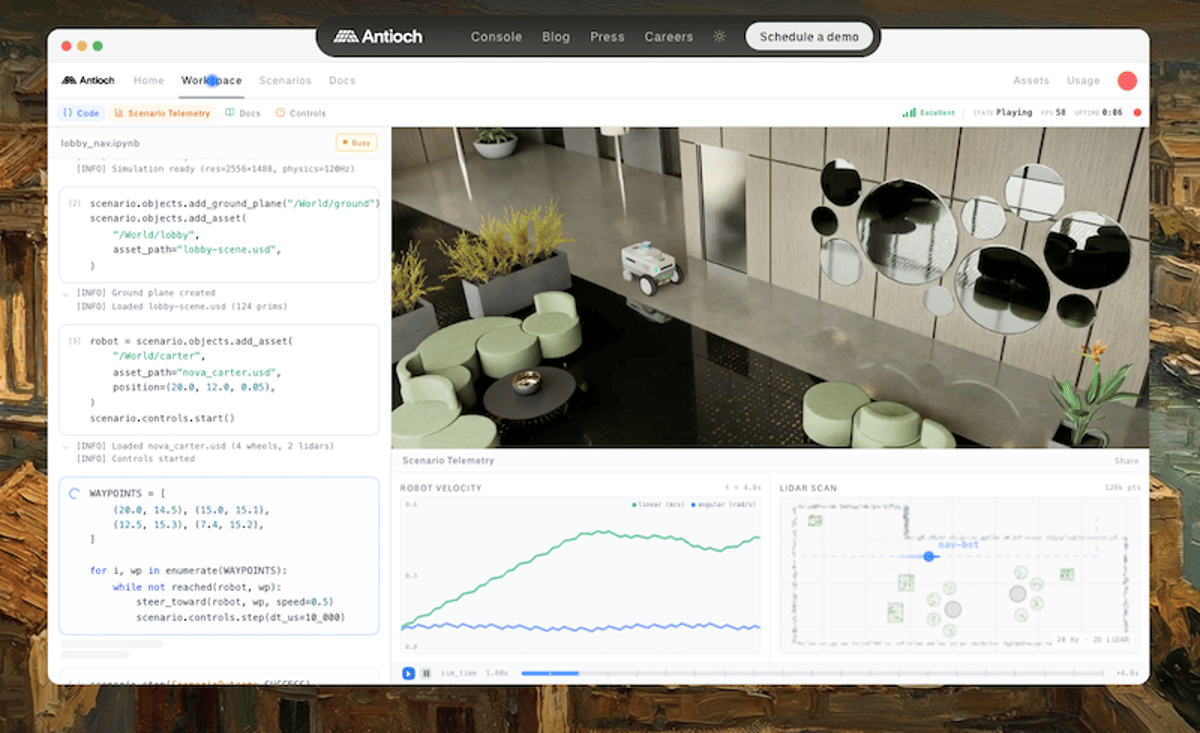
Antioch Raises $8.5 Million to Accelerate Simulation-Based Development of Autonomous Systems
Companies Mentioned


Why It Matters
By virtualizing testing, Antioch lowers barriers for robotics innovators, speeding time‑to‑market and expanding access to high‑fidelity simulation that was previously affordable only to deep‑pocketed incumbents.
Key Takeaways
- •Antioch secured $8.5 M Series round led by A* and Category Ventures.
- •Platform lets robotics teams run infinite simulated scenarios, cutting physical test costs.
- •Early adopters include Fortune 500 tech, logistics firms, and FAANG engineering groups.
- •Founders bring experience from Tesla Autopilot, DeepMind, and Chainalysis acquisition.
- •Simulation could unlock $50 T physical‑AI market, dwarfing LLM impact.
Pulse Analysis
The robotics industry has long wrestled with the high cost and limited scope of physical testing. Renting warehouses, building mock‑ups, and resetting hardware after each run can drain millions from a development budget. Antioch’s cloud‑native simulation platform promises to replace those constraints with a virtual environment that can replicate countless real‑world conditions at a fraction of the price. This shift not only reduces capital outlays but also accelerates iteration cycles, allowing teams to validate algorithms faster and with greater safety margins.
Underlying Antioch’s offering are recent breakthroughs in physics engines, photorealistic rendering, and generative world‑model AI. By stitching together Nvidia‑powered simulation cores with emerging generative models from firms like World Labs, the platform delivers high‑fidelity, deterministic scenarios that mirror complex urban, industrial, and aerial settings. The company positions itself as a unifying layer, abstracting the fragmented toolbox of simulation components into a developer‑friendly interface—much like how Cursor streamlines access to large language models. This abstraction lets engineers plug in their autonomous stacks once and continuously benefit from backend upgrades without re‑architecting their pipelines.
The market implications are sizable. Analysts estimate that physical‑AI applications in manufacturing, logistics, construction, energy, and agriculture represent roughly $50 trillion of global economic activity—far exceeding the $8 trillion LLM‑driven software market. By democratizing high‑end simulation, Antioch could enable a new wave of embodied‑AI startups to compete with incumbents that currently spend hundreds of millions annually on in‑house test facilities. Investors see this as a catalyst for reindustrialization, offering a scalable path for U.S. firms to reclaim manufacturing leadership through robotics and automation. As simulation becomes the de‑facto safety net for autonomous deployments, platforms like Antioch are poised to become essential infrastructure for the next industrial revolution.
Antioch raises $8.5 million to accelerate simulation-based development of autonomous systems
Comments
Want to join the conversation?
Loading comments...