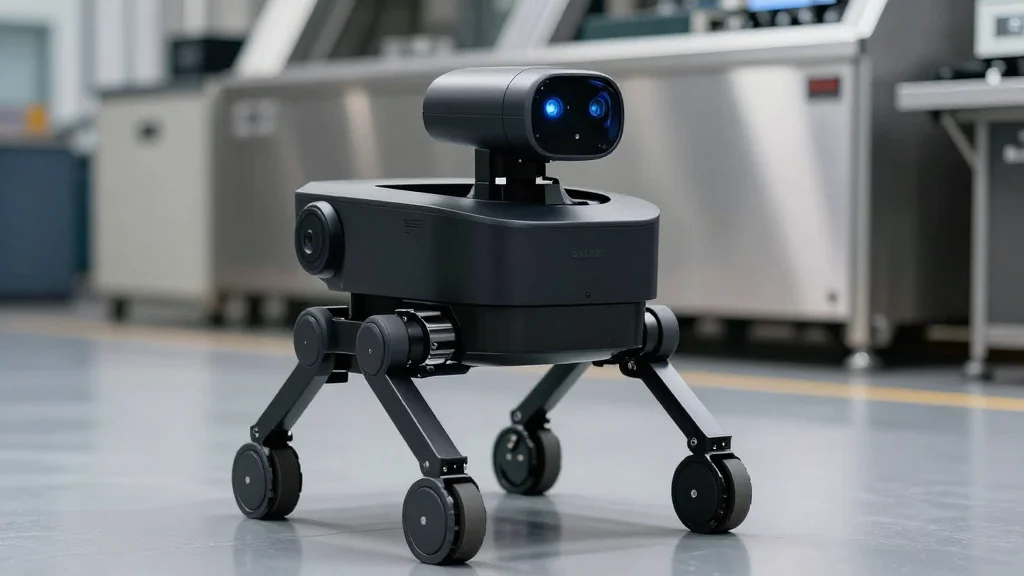
Boston Dynamics Teams with DeepMind to Add Embodied AI to Spot Inspection Robots

Companies Mentioned


Why It Matters
The integration of DeepMind’s Gemini model into Spot signals a turning point for autonomous industrial inspection, moving robots from passive sensors to active decision‑makers. By enabling real‑time instrument reading and transparent reasoning, the partnership addresses two long‑standing barriers: the need for precise, context‑aware data and the demand for auditability in safety‑critical environments. If successful, the technology could dramatically cut inspection labor costs, reduce unplanned downtime, and set new safety standards across sectors that rely on continuous equipment monitoring. Moreover, the collaboration showcases how leading AI research labs can accelerate commercial robotics adoption through focused, domain‑specific models. This could spur a wave of similar partnerships, driving a virtuous cycle of data collection, model improvement and broader deployment, ultimately reshaping the economics of factory automation.
Key Takeaways
- •Boston Dynamics integrates DeepMind’s Gemini Robotics‑ER 1.6 into Spot’s AIVI platform
- •New capabilities include instrument reading, success detection and transparent reasoning
- •Zero‑downtime cloud upgrades allow continuous model improvements without halting inspections
- •Live deployment began earlier this month for existing Spot customers
- •Partnership positions Spot as a leading autonomous inspection solution in industrial markets
Pulse Analysis
The Boston Dynamics‑DeepMind alliance is more than a technology plug‑in; it is a strategic play to lock in a dominant position in the emerging market for autonomous inspection. Spot already enjoys a strong brand and a robust ecosystem of developers, but its value proposition has been limited by perception‑only capabilities. By adding embodied reasoning, Boston Dynamics transforms Spot into a cognitive agent that can not only see but also interpret and act on complex visual cues. This leap narrows the gap between human inspectors and robots, making the economics of full‑time autonomous monitoring more compelling.
Historically, robotics firms have struggled to monetize AI upgrades because model retraining often required on‑premise hardware changes. The cloud‑centric approach championed by Boston Dynamics—zero‑downtime upgrades and continuous learning—mirrors the software‑as‑a‑service model that has driven growth in enterprise IT. If the company can demonstrate measurable ROI—fewer safety incidents, lower labor spend, and higher equipment availability—it will likely accelerate subscription‑based revenue streams and create a defensible moat against rivals.
Looking ahead, the real test will be scaling the system across diverse facilities with varying lighting, layout and regulatory constraints. The need for data sharing to improve AIVI‑Learning raises privacy and security questions that could slow adoption in highly regulated sectors. Nonetheless, the partnership sets a clear benchmark: future industrial robots will need to combine mobility, perception and reasoning in a single, updatable package. Companies that fail to integrate these layers risk obsolescence as customers gravitate toward platforms that can deliver both operational insight and compliance transparency.
Boston Dynamics Teams with DeepMind to Add Embodied AI to Spot Inspection Robots
Comments
Want to join the conversation?
Loading comments...