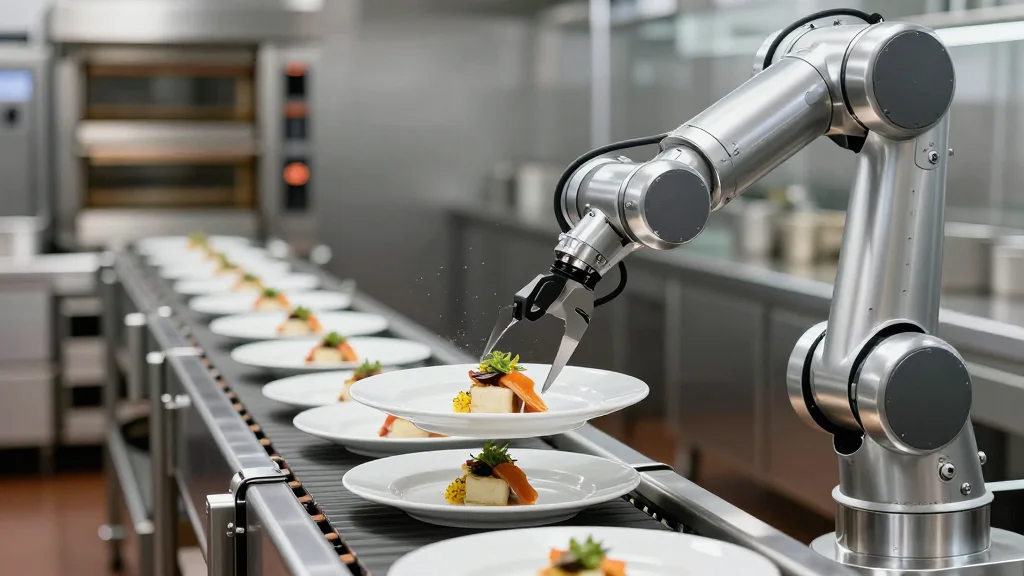
Chef Robotics Hits 100 Million Servings Milestone, Aims to Scale Kitchen Automation

Companies Mentioned

Why It Matters
Chef Robotics’ breakthrough demonstrates that the kitchen‑automation market can achieve scale when startups target institutional customers with high throughput and predictable processes. By converting 100 million servings into actionable AI data, the company showcases a feedback loop that can accelerate robot learning and reduce costs, potentially lowering barriers for broader adoption across the food‑service industry. If Chef Robotics can sustain growth and expand into new verticals such as airline catering and ghost kitchens, it could revive investor confidence in food‑service robotics, encouraging fresh capital inflows and prompting larger incumbents to accelerate their own automation initiatives. This shift may reshape labor dynamics in large‑scale food production, driving efficiency gains while raising questions about workforce displacement and the need for new skill sets.
Key Takeaways
- •Chef Robotics crossed 100 million robot‑served portions, a key scale metric
- •Pivoted from fast‑casual restaurants to food manufacturers and school‑lunch providers
- •Secured a contract with one of the world’s largest airline catering companies
- •AI models are trained on data from each serving to improve handling of slippery foods
- •Industry sees renewed optimism after past failures like Chowbotics and Zume
Pulse Analysis
Chef Robotics’ trajectory underscores a strategic lesson for robotics startups: success often lies in aligning technology with environments that demand consistency over novelty. Early attempts to automate fast‑casual dining stumbled because they required robots to navigate highly variable menus, unpredictable human interactions, and thin profit margins. By moving into institutional kitchens, Chef Robotics leverages economies of scale and a more controlled set of food items, allowing its AI to iterate rapidly on a massive data set.
The 100 million‑serving milestone is not merely a vanity number; it represents a substantial corpus of labeled data that can be used to train deep‑learning models for grasping, placement and packaging. This data advantage could create a defensible moat, as competitors would need comparable volumes to achieve similar performance. Moreover, the partnership with a major airline caterer signals validation from a high‑stakes client where food safety and reliability are non‑negotiable, potentially opening doors to other regulated sectors such as healthcare food services.
Looking forward, the company’s ambition to enter ghost kitchens and eventually fast‑casual venues will test its ability to generalize AI models beyond the relatively uniform institutional setting. Success will require modular hardware, adaptable software pipelines, and robust supply‑chain integration. If Chef Robotics can navigate these challenges, it may catalyze a broader wave of automation across the food‑service ecosystem, prompting legacy players to either partner with or acquire such technology to stay competitive.
Chef Robotics Hits 100 Million Servings Milestone, Aims to Scale Kitchen Automation
Comments
Want to join the conversation?
Loading comments...