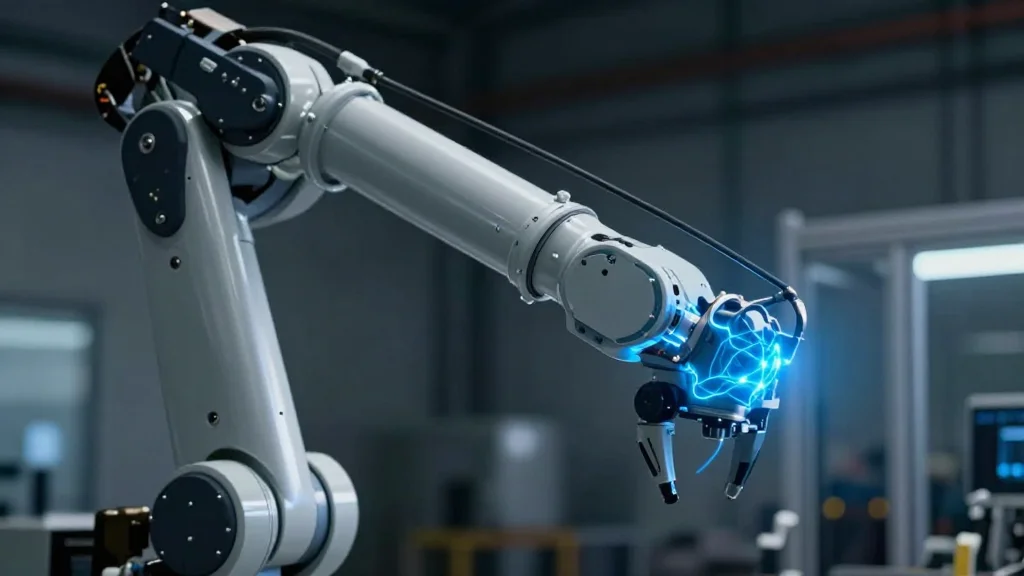
Fanuc Shares Surge 16% After Google AI Robotics Partnership

Companies Mentioned

Why It Matters
Embedding Google’s Gemini Enterprise into Fanuc’s robot arms could dramatically shorten the time required for manufacturers to adopt AI‑driven automation, lowering barriers to entry for midsize factories that lack deep in‑house data science teams. By offering a cloud‑native AI layer, Fanuc may accelerate the shift from static, pre‑programmed motions to adaptive, self‑optimizing processes, driving productivity gains across sectors that are critical to global supply chains. The deal also signals a convergence of two traditionally separate technology domains—industrial hardware and consumer‑grade AI—potentially reshaping competitive dynamics. If Fanuc’s AI‑enhanced robots deliver measurable ROI, other OEMs will be compelled to secure similar partnerships, intensifying the race for cloud AI supremacy in the manufacturing arena. This could spur further consolidation, with larger tech firms seeking footholds in the high‑margin robotics market, while smaller robot makers may look to differentiate through niche AI applications or open‑source alternatives.
Key Takeaways
- •Fanuc shares rose up to 16% to an intraday record after the Google partnership announcement.
- •The collaboration will use Google Cloud’s Gemini Enterprise AI model to power Fanuc’s industrial robots.
- •Fanuc aims to launch a pilot AI‑enhanced robot system later in 2026, with full rollout expected by 2027.
- •Analysts project the global industrial robotics market to reach $200 billion by 2030, growing at ~10% CAGR.
- •The partnership could trigger a wave of AI‑cloud integrations among rivals like ABB, KUKA and Yaskawa.
Pulse Analysis
Fanuc’s decision to partner with Google reflects a strategic pivot from pure hardware excellence to a hybrid model where software and data become core differentiators. Historically, Fanuc built its moat on reliability and scale, but the rise of AI‑enabled perception and decision‑making threatens to erode that advantage unless the company can offer smarter, more flexible robots. By tapping Google’s Gemini Enterprise, Fanuc sidesteps the lengthy, costly process of building its own large‑scale language model, instead leveraging a platform that already powers a range of enterprise applications. This accelerates time‑to‑market and positions Fanuc to capture early adopters eager for plug‑and‑play AI.
From a market perspective, the partnership could catalyze a broader shift toward cloud‑centric robotics. Manufacturers are increasingly comfortable with SaaS models for ERP and PLM; extending that comfort to robot control could unlock subscription‑based revenue streams for OEMs. However, reliance on a single cloud provider introduces risk—service outages or geopolitical data restrictions could disrupt production lines. Competitors may respond by diversifying cloud partners or developing edge‑first AI solutions that keep critical inference on‑premise.
In the longer term, the success of Fanuc‑Google’s joint offering will likely influence M&A activity in the sector. If the AI‑enhanced robots demonstrate clear cost savings and productivity lifts, larger tech conglomerates may pursue acquisitions of niche robot manufacturers to secure hardware footholds, while traditional robot makers could double‑down on AI partnerships to stay relevant. The next few quarters will be a litmus test for whether cloud AI can truly become a commodity in the factory floor, or if the industry will settle on a hybrid approach that balances cloud intelligence with on‑site resilience.
Fanuc Shares Surge 16% After Google AI Robotics Partnership
Comments
Want to join the conversation?
Loading comments...