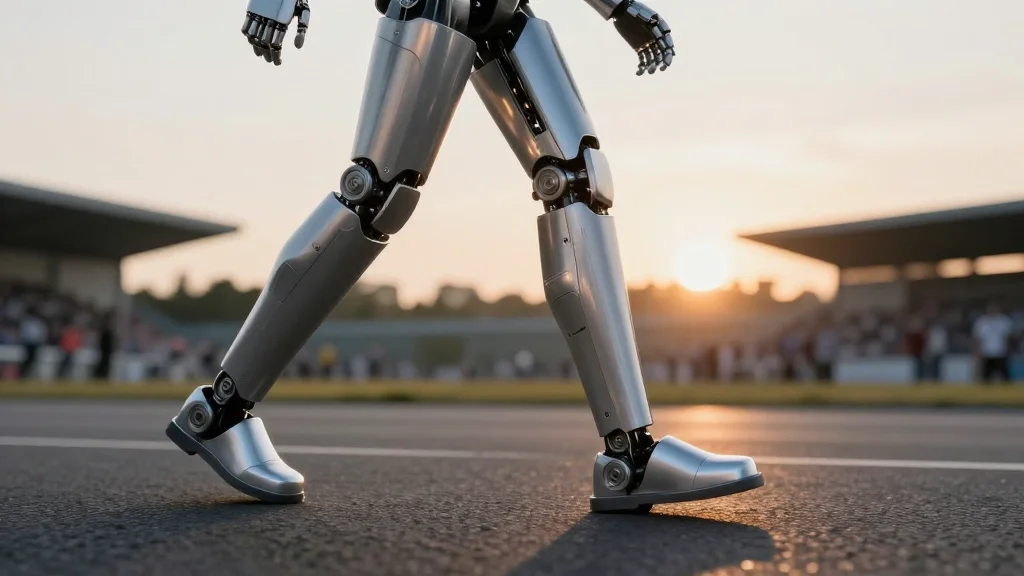
Honor's Lightning Beats Human Half‑Marathon Record in Beijing, Matching Runners for Second Year

Why It Matters
The Lightning victory signals that humanoid robots are moving from controlled lab environments into public, high‑visibility arenas. By beating the human half‑marathon record, the robot demonstrates that legged platforms can sustain high speeds over long distances, a prerequisite for applications such as last‑mile delivery, search‑and‑rescue, and infrastructure inspection. Moreover, the massive online audience shows a growing consumer appetite for robot‑centric entertainment, hinting at new revenue streams for manufacturers and media partners. At a policy level, the event forces regulators to confront questions about safety standards, liability, and the permissible degree of autonomy in public spaces. As robots begin to share sidewalks, tracks, and stadiums with people, governments will need to craft guidelines that balance innovation with public protection, shaping the trajectory of the entire robotics ecosystem.
Key Takeaways
- •Honor's Lightning finished the Beijing half‑marathon in 50:26, ~7 minutes faster than the men's human world record.
- •More than 100 robot teams from 16 countries entered the humanoid category, with <40% fully autonomous.
- •YouTube views of the race exceeded 8 million, indicating strong public interest.
- •The Chinese humanoid market is projected to hit $14.6 billion by 2030, driven by events like this.
- •A YouGov 2025 survey found 33% of U.S. sports fans would watch leagues featuring robot athletes.
Pulse Analysis
Lightning’s record‑breaking run is less a one‑off stunt and more a data point in a broader trend: legged robots are finally achieving the power‑to‑weight ratios needed for sustained high‑speed locomotion. Historically, bipedal platforms lagged behind wheeled or quadruped systems because of energy inefficiency and balance control. Advances in actuator design, lightweight composites, and AI‑driven gait optimization have narrowed that gap, allowing machines like Lightning to maintain a 3.5 m/s pace for over 21 km.
From a market perspective, the spectacle serves as a catalyst for capital inflows. Venture firms that previously funded humanoid startups for niche industrial tasks are now eyeing consumer‑facing applications, betting that the entertainment value will translate into commercial demand. The projected $14.6 billion Chinese humanoid market, combined with the 8 million‑view audience, suggests a viable business case for manufacturers to bundle performance showcases with product rollouts.
However, the race also exposes the fragility of current autonomy stacks. Lightning’s collision underscores that perception‑action loops still struggle with unstructured obstacles—a problem that could stall widespread adoption in public domains. Companies will need to invest heavily in sensor fusion, edge‑AI processing, and fail‑safe architectures before regulators grant broader operating permissions. In the short term, we can expect a surge in hybrid‑control models—where robots run autonomously but remain tethered to human supervisors—mirroring the approach taken at the Beijing event.
Looking ahead, the upcoming World Humanoid Robot Games will likely push the envelope further, introducing more complex terrains and interactive challenges. Success there could unlock new verticals, from autonomous construction crews to crowd‑control units, fundamentally reshaping how societies integrate machines into daily life.
Honor's Lightning Beats Human Half‑Marathon Record in Beijing, Matching Runners for Second Year
Comments
Want to join the conversation?
Loading comments...