I Met a Lot of Weird Robots at CES — Here Are the Most Memorable
•January 10, 2026
0
Companies Mentioned


Why It Matters
The showcase signals that commercial robotics are moving from lab demos to real‑world deployments across retail, hospitality, and home environments, reshaping labor and consumer experiences.
Key Takeaways
- •Atlas now production‑ready, signaling wider industrial adoption
- •Dyna raised $120M, backing from Nvidia, Amazon, Samsung
- •Galbot demoed LLM‑driven store assistant, real‑world deployments
- •Unitree’s humanoid runs 11 mph, showcasing speed advances
- •CES robots highlight shift from demos to functional services
Pulse Analysis
The 2026 Consumer Electronics Show highlighted a pivotal moment for commercial robotics, with Boston Dynamics finally unveiling Atlas as a production‑ready platform. Atlas’s robust locomotion and payload capacity suggest broader adoption in logistics and construction, moving the technology out of research labs and into enterprise workflows. This milestone reflects a growing confidence among investors and manufacturers that humanoid robots can deliver tangible ROI in demanding industrial settings.
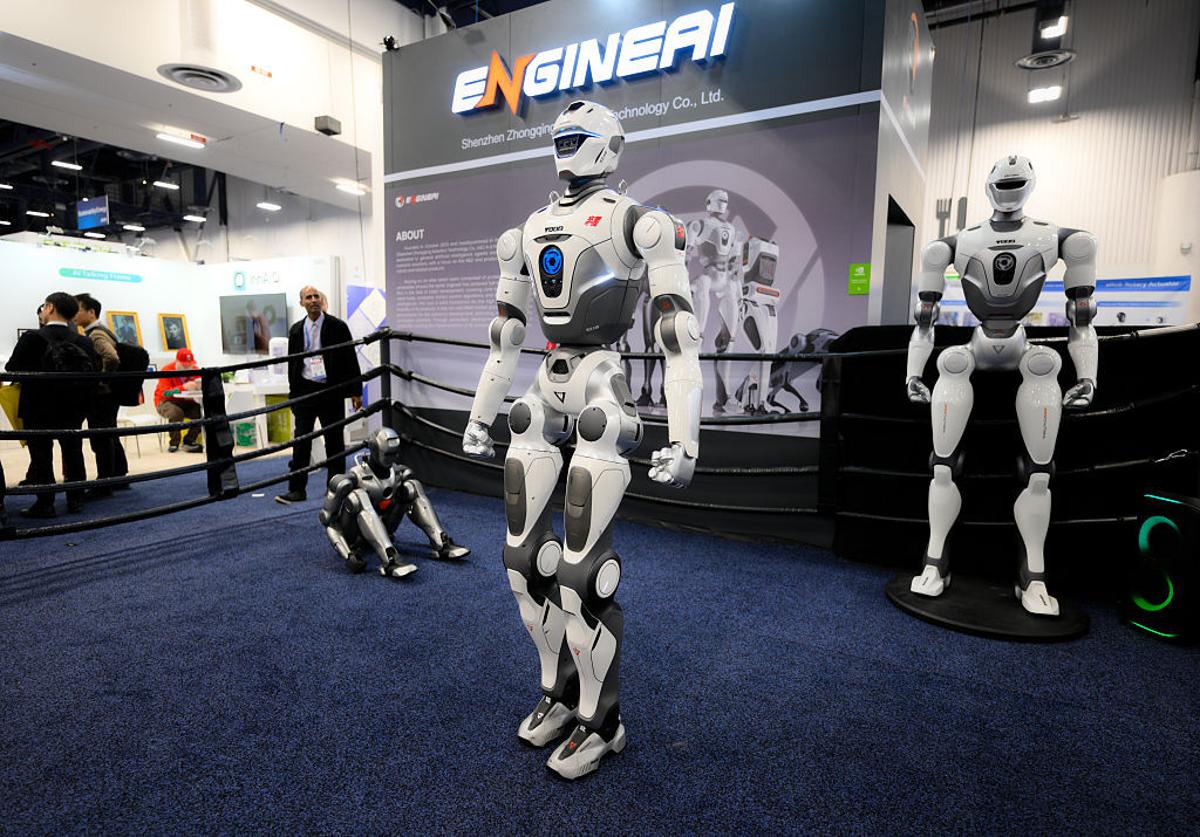
Beyond heavyweight industrial units, the exhibition floor brimmed with consumer‑focused bots that blend AI, perception, and mechanical agility. Sharpa’s ping‑pong robot illustrated the precision of its modular hand, while EngineAI’s T800s used shadow‑boxing to demonstrate balance and reactive control without actual impact. Unitree’s dancing humanoid, capable of 11 mph sprints, showcased rapid locomotion that could translate to delivery or security patrols. Meanwhile, Galbot’s LLM‑integrated convenience‑store clerk proved that large language models can orchestrate physical tasks, hinting at future retail assistants that converse, navigate, and fulfill orders autonomously.
Perhaps the most commercially significant display came from Dyna Robotics, whose dual‑arm system now folds laundry at scale. Backed by a $120 million Series A round featuring Nvidia, Amazon, LG, Salesforce, and Samsung, Dyna’s technology has already been deployed in hotels, gyms, and the first North‑American robotic laundry center. This infusion of capital and real‑world pilots signals that service robots are transitioning from novelty to essential infrastructure, promising cost reductions and new revenue streams for sectors traditionally reliant on manual labor. As the ecosystem matures, we can expect accelerated integration of AI‑driven robots across supply chains, consumer touchpoints, and domestic environments.
I met a lot of weird robots at CES — here are the most memorable
0
Comments
Want to join the conversation?
Loading comments...