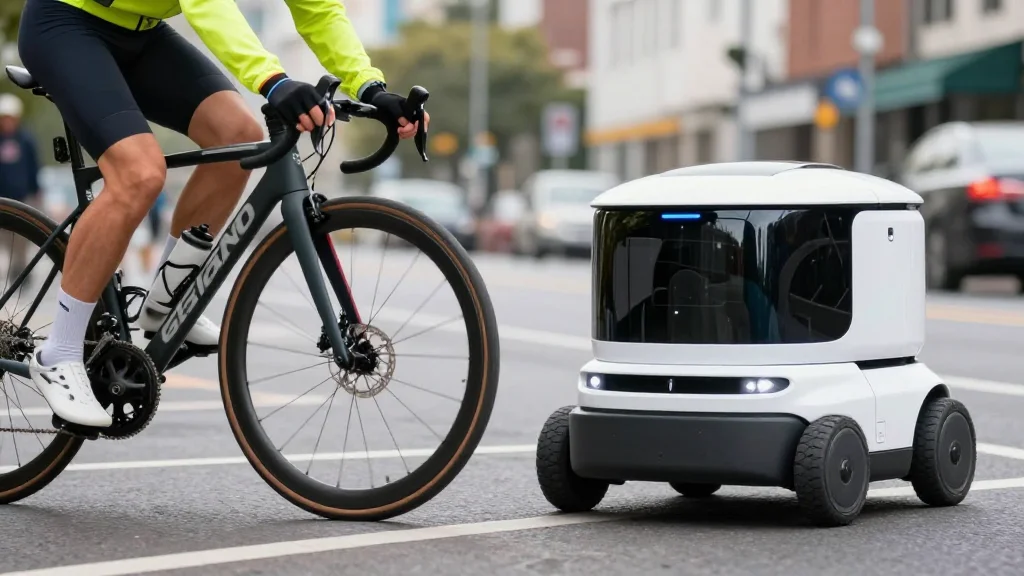
Jersey City Cyclist Sues Uber and Avride Over Autonomous Delivery Robot Crash

Companies Mentioned
Why It Matters
The lawsuit marks the first major legal challenge directly linking a cyclist’s injuries to an autonomous delivery robot, raising fundamental questions about liability when a machine operating without a human driver causes harm. It forces policymakers to confront whether existing traffic and pedestrian safety statutes adequately cover low‑speed, sidewalk‑level robots, or if new regulations are needed to protect vulnerable road users. Beyond the courtroom, the case could influence investor confidence in the autonomous‑delivery sector. Companies that have raised hundreds of millions of dollars on the promise of safe, scalable robot fleets may see valuations adjust if courts impose strict liability standards. The broader robotics industry will watch closely to see whether safety assurances—often based on sensor redundancy and AI‑driven navigation—hold up under legal scrutiny, potentially reshaping product development roadmaps.
Key Takeaways
- •Jersey City cyclist Conor Shannon plans to sue Uber and Avride after a self‑driving robot entered his bike lane and caused a concussion and broken clavicle.
- •Avride’s robots are 33 inches tall, travel up to 5 mph, carry up to six pizzas, and have a 31‑mile range on a single charge.
- •Uber announced its partnership with Avride in Oct. 2024; the service launched in Jersey City in Feb. 2025 and Philadelphia in Mar. 2025.
- •Avride claims a three‑layer sensor system makes collisions "out of the question," but the Varick Street incident challenges that assertion.
- •Legal experts warn the case could set a precedent for liability standards and municipal regulations governing autonomous sidewalk robots.
Pulse Analysis
The Shannon lawsuit arrives at a crossroads for autonomous delivery robotics, where rapid commercial rollout is colliding with nascent safety frameworks. Historically, low‑speed delivery bots have been treated as "smart carts" rather than vehicles, allowing companies to sidestep many of the regulatory hurdles that apply to autonomous cars. This legal action forces a re‑examination of that assumption, especially as robots begin to share space with cyclists, pedestrians, and even motorized scooters.
Investors have poured roughly $2 billion into U.S. autonomous‑delivery startups over the past three years, betting on economies of scale and the promise of reduced last‑mile costs. A liability ruling that holds platform operators like Uber directly responsible for robot‑related injuries could dramatically increase insurance premiums and operational costs, compressing margins and slowing expansion. Companies may respond by over‑engineering safety features—adding redundant LiDAR, higher‑resolution cameras, or even human‑in‑the‑loop supervision—driving up capital expenditures.
Regulators, meanwhile, are likely to tighten oversight. Cities that have previously granted blanket permits may now require detailed incident reporting, mandatory safety audits, and proof of insurance coverage. If municipalities adopt stricter standards, the competitive landscape could shift in favor of firms that have already integrated robust safety architectures, such as Nuro’s enclosed pod design, while pure‑software players could find themselves at a disadvantage. Ultimately, the case could become a benchmark for how the U.S. balances innovation with public safety in the burgeoning robotics economy.
Jersey City Cyclist Sues Uber and Avride Over Autonomous Delivery Robot Crash
Comments
Want to join the conversation?
Loading comments...