NASA Let AI Drive The Perseverance Rover For Two Days
•February 9, 2026
0
Companies Mentioned

Why It Matters
The demonstration proves AI can extend rover autonomy, boosting science return while reducing reliance on delayed Earth‑based commands. It paves the way for future missions that must operate far from direct human oversight.
Key Takeaways
- •AI generated safe waypoints for 456 m rover drive.
- •Claude AI analyzed orbital imagery and elevation models.
- •Autonomous navigation reduced human planning workload.
- •Uncertainty grows; AI re‑localization under development.
- •Future rovers may use AI swarms and Titan drones.
Pulse Analysis
The roughly 25‑minute round‑trip signal lag between Earth and Mars forces every surface mission to operate with a degree of independence. Historically, rover teams have compensated by manually selecting waypoints every few hundred meters, a process that consumes valuable engineering time and limits the distance a vehicle can travel before a new command is needed. Recent advances in generative artificial intelligence have begun to close that gap, offering the ability to interpret orbital datasets, assess terrain hazards, and propose navigation routes without direct human input.
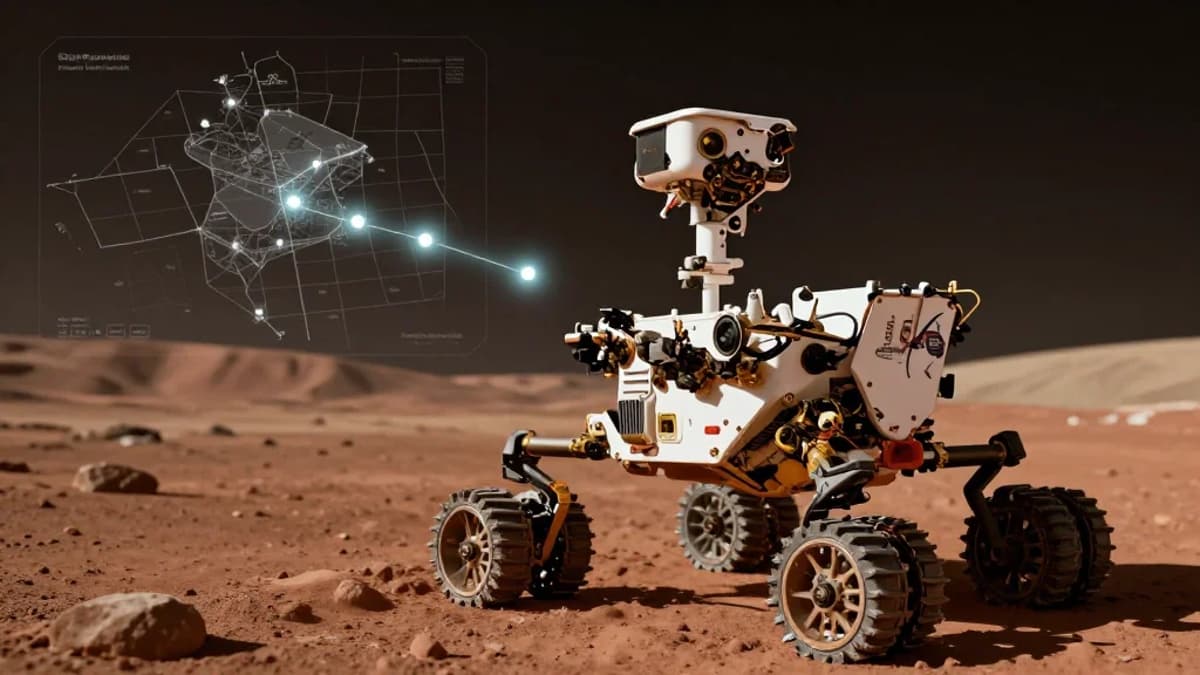
In the latest Perseverance trial, an Anthropic Claude model ingested high‑resolution HiRISE imagery and digital elevation models, then produced a series of waypoints that guided the rover for 456 meters across two days. The AI‑derived path avoided sand traps, boulders and steep slopes, after which the rover’s onboard auto‑navigation system executed the plan autonomously. By offloading waypoint creation to a cloud‑based model and validating it on a twin testbed, NASA demonstrated a workflow that can shrink the planning‑to‑execution cycle and mitigate positional uncertainty that traditionally required human re‑localization.
The success of this experiment signals a shift toward fully autonomous planetary explorers. Future Mars rovers could undertake kilometer‑scale traverses, while AI‑enhanced re‑localization techniques promise tighter navigation confidence without Earth‑based intervention. Moreover, the same generative‑AI framework is slated for NASA’s Dragonfly mission to Titan and for coordinated drone swarms that would extend a rover’s scientific reach. For the broader aerospace sector, these capabilities translate into lower mission costs, higher science return, and a competitive edge in deep‑space exploration as agencies race to establish a sustainable presence on the Moon and beyond.
NASA Let AI Drive The Perseverance Rover For Two Days
0
Comments
Want to join the conversation?
Loading comments...