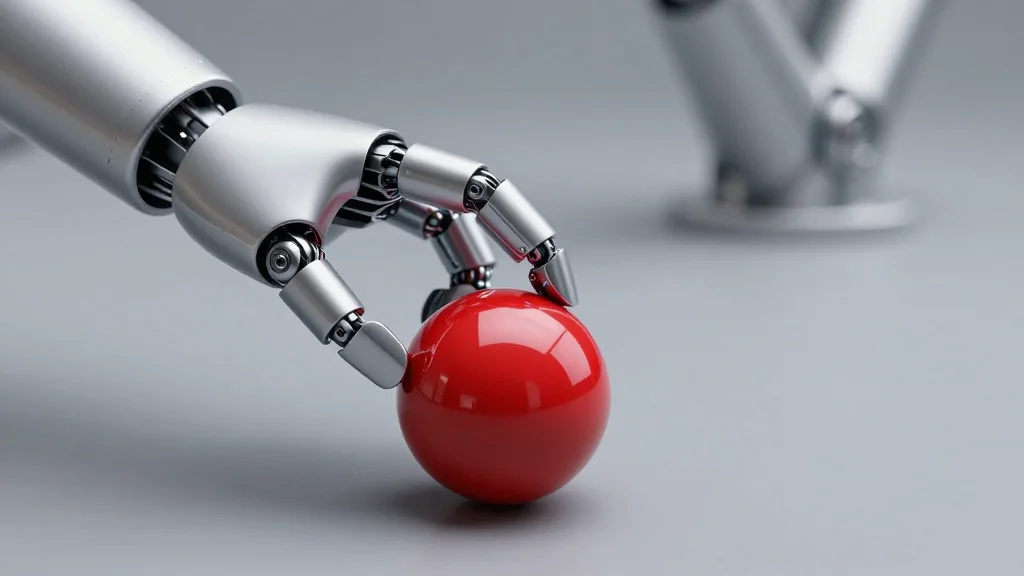
OpenAI's OpenClaw Agent Controls Physical Arm to Autonomously Grab Objects

Companies Mentioned


Why It Matters
The OpenClaw experiment proves that large language models can move beyond simulation and directly command physical hardware, a milestone for embodied AI. By turning code generation into a robot‑programming workflow, the approach could democratize robotics, allowing small teams to prototype automation without deep expertise. This could accelerate adoption of collaborative robots in manufacturing, logistics and even consumer products, reshaping labor dynamics and supply‑chain resilience. Moreover, the success fuels a competitive race among AI labs to produce models that understand both language and the physics of the world. As benchmarks like CaP‑X highlight, multimodal training is becoming a decisive factor, prompting firms such as Google DeepMind, Nvidia and OpenAI to invest heavily in joint research that blurs the line between software and hardware intelligence.
Key Takeaways
- •OpenAI's OpenClaw paired with a LeRobot 101 arm autonomously calibrated and grasped a red ball.
- •Ken Goldberg highlighted code‑as‑policy as a bridge between reliable engineering and generalizable vision‑language models.
- •Spencer Huang noted the approach could let "nearly anyone" build robots, lowering entry barriers.
- •CaP‑X benchmark shows Gemini outperforms Claude and ChatGPT on robot‑programming tasks.
- •Nvidia plans to embed CaP‑Gym into its Jetson platform, aiming for broader industrial adoption.
Pulse Analysis
The OpenClaw showcase is less a product launch than a proof‑of‑concept that could redefine how robotics software is authored. Historically, robot developers have spent months writing low‑level drivers and tuning PID loops for each new manipulator. By delegating that work to a language model, firms can compress development timelines from months to days, a shift comparable to the impact of high‑level programming languages in the 1970s. However, the transition is not frictionless. Language models still hallucinate, and safety‑critical applications demand deterministic behavior that stochastic code generation struggles to guarantee. The industry will likely see a hybrid model emerge: language‑driven prototyping followed by rigorous verification pipelines.
From a market perspective, the demonstration could accelerate venture capital flow into startups that package code‑as‑policy platforms with off‑the‑shelf hardware. Nvidia's involvement signals that GPU manufacturers recognize the value of providing end‑to‑end stacks—from simulation environments to on‑device inference—that enable real‑time robot control. Meanwhile, established automation players such as ABB and Fanuc may need to acquire or partner with AI firms to stay relevant, as their traditional PLC‑centric ecosystems lack the flexibility to ingest natural‑language commands.
Looking forward, the key question is scalability. Will code‑as‑policy handle multi‑axis coordination, force feedback and dynamic environments as reliably as dedicated motion planners? If research groups can close that gap, we could witness a wave of plug‑and‑play robotic workcells that non‑engineers configure via simple prompts—potentially reshaping manufacturing, warehousing and even home assistance. The next six months of benchmark releases and open‑source toolkits will be a litmus test for whether this vision moves from novelty to industry standard.
OpenAI's OpenClaw Agent Controls Physical Arm to Autonomously Grab Objects
Comments
Want to join the conversation?
Loading comments...