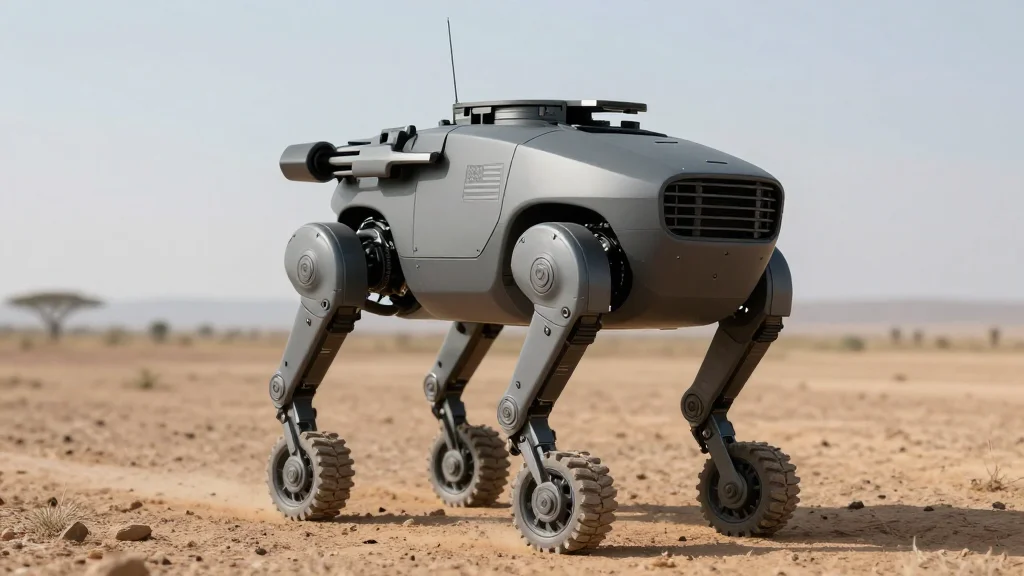
U.S. Army Tests Autonomous Weapons and Combat Robots in Africa Lion 2026

Companies Mentioned

Why It Matters
The African Lion 2026 exercise marks the first large‑scale field test of AI‑driven combat robots and autonomous weapons by the U.S. Army, signaling a decisive move toward machine‑augmented warfare. By compressing the kill‑chain to minutes, the technology could reshape battlefield dynamics, giving U.S. forces a speed advantage while also raising the stakes for adversaries seeking similar capabilities. Beyond tactical gains, the drill spotlights a policy crossroads: how to integrate autonomous lethality without sacrificing legal and moral accountability. The outcomes will influence defense procurement, legislative oversight, and international norms governing the use of AI in armed conflict.
Key Takeaways
- •U.S. Army deployed AI‑powered combat robots and autonomous gun platforms in African Lion 2026.
- •Kill‑chain decision time shrank from 2‑3 hours to 3 minutes using Palantir’s Project Maven and Anthropic’s Claude.
- •Lt. Col. Ramon Leonguerrero confirmed human approval remained for final strikes, but fully autonomous prototypes were demonstrated.
- •More than a dozen defense contractors participated, positioning the exercise as a multi‑billion‑dollar procurement catalyst.
- •Ethical concerns surfaced, with soldiers and human‑rights groups questioning delegation of lethal decisions to machines.
Pulse Analysis
African Lion 2026 is a watershed moment for military robotics, not because the hardware is novel—robots that can carry weapons have been in development for years—but because the integration of AI at the decision layer reached operational scale. The Army’s reliance on Palantir’s data‑fusion engine and Anthropic’s language model illustrates a broader trend: the convergence of commercial AI breakthroughs with legacy defense systems. This partnership accelerates the fielding timeline, but it also ties the Pentagon to private‑sector roadmaps that may shift with market pressures.
Historically, the U.S. military has been cautious about fully autonomous weapons, favoring “human‑in‑the‑loop” architectures after the 2018 NATO discussions on lethal autonomous systems. The African Lion drill suggests a pragmatic compromise: use AI to triage and prioritize targets while preserving human authority over the final kill. If the Army can prove that this hybrid model reduces civilian casualties, it could set a de‑facto standard that other nations emulate, potentially lowering the threshold for autonomous weapon adoption worldwide.
From a competitive standpoint, the exercise puts pressure on rival powers—China, Russia, and emerging AI‑focused militaries—to showcase comparable capabilities. The public nature of the test, amplified by media coverage, may spur an arms race in AI‑enabled robotics, prompting faster procurement cycles and greater budget allocations for autonomous systems. However, the ethical backlash from soldiers on the ground and advocacy groups could force tighter congressional oversight, shaping the regulatory environment for the next decade.
Looking ahead, the Army’s roadmap includes scaling the AI stack to brigade‑level units and testing in urban environments where the risk of collateral damage is higher. Success could unlock a new class of “smart” combat platforms that operate semi‑autonomously, freeing human operators for higher‑order tasks. Failure, or a high‑profile mishap, could trigger a policy reversal and a re‑emphasis on human‑centric warfare. The stakes are therefore both technological and geopolitical, making African Lion 2026 a bellwether for the future of combat robotics.
U.S. Army tests autonomous weapons and combat robots in Africa Lion 2026
Comments
Want to join the conversation?
Loading comments...