
Companies Mentioned


Why It Matters
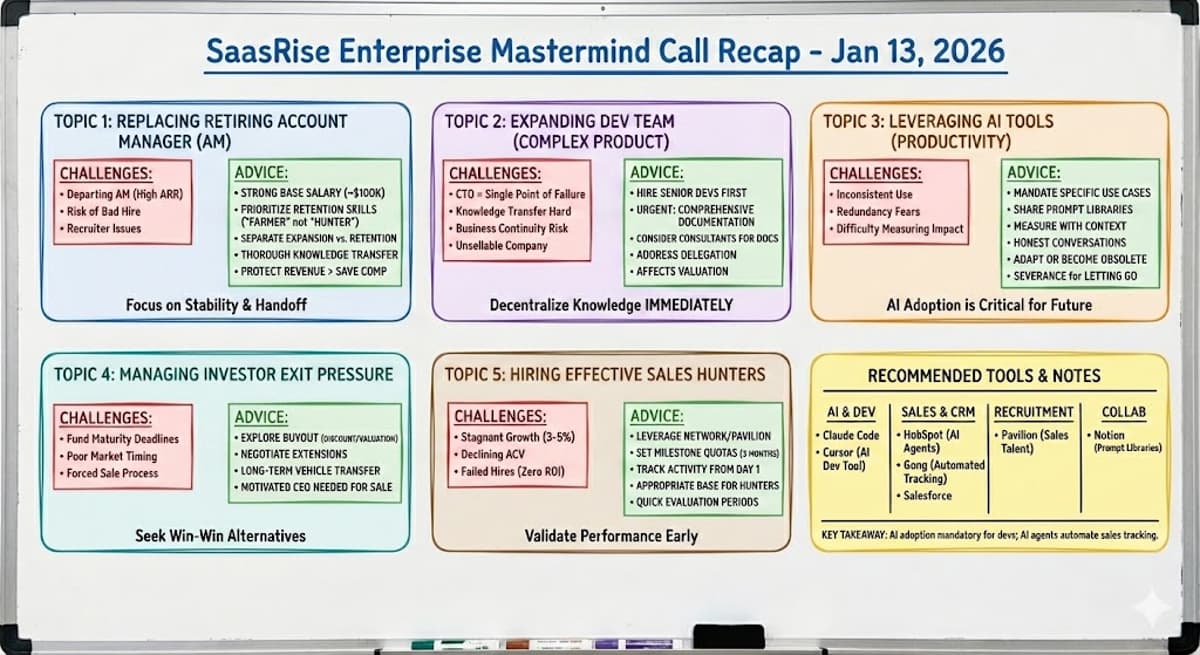
These recommendations help SaaS companies protect recurring revenue, accelerate product development, and preserve valuation amid market and investor pressures, turning talent risk into a competitive advantage.
Key Takeaways
- •Base salary ~100K attracts quality account managers.
- •Senior developers first; document complex systems immediately.
- •Mandatory AI tool usage drives developer productivity.
- •Buy out investors or extend deadlines to protect valuation.
- •Set 2‑month evaluation for sales hunters with clear quotas.
Pulse Analysis
Talent acquisition remains the linchpin of SaaS growth, especially when a high‑performing account manager departs. The call urged firms to offer a solid $100K base salary to attract retention‑focused candidates, separating expansion duties to avoid over‑stretching. For sales hunters, leveraging personal networks, setting three‑month pipeline milestones, and enforcing a two‑month performance window ensures that only true revenue generators stay on board, directly safeguarding ARR and improving sales efficiency.
Scaling the engineering organization requires a disciplined approach. Prioritizing senior hires who can quickly grasp complex architectures reduces the single‑point‑failure risk inherent in founder‑led codebases. Immediate investment in comprehensive documentation—often with specialist consultants—creates a knowledge repository that accelerates onboarding and protects valuation. The mastermind also made AI adoption non‑negotiable; tools like Claude Code and Cursor now handle up to 60% of coding tasks, and establishing prompt libraries in Notion standardizes best practices, turning AI proficiency into a measurable productivity lever.
Investor exit pressure adds another strategic layer. When fund‑maturity deadlines clash with unfavorable market timing, companies can negotiate buyouts at discounted valuations, extend contractual deadlines, or structure earn‑out provisions to keep investors whole while preserving upside. A motivated CEO is essential to steer the sale process, and clear communication about timeline adjustments can prevent rushed transactions that erode company value. Together, these talent, technology, and financial tactics equip SaaS leaders to navigate growth challenges with confidence.
SaasRise Enterprise Mastermind Call Recap Jan 13, 2026
0
Comments
Want to join the conversation?
Loading comments...