The AI Coding Revolution: How Claude and AI Assistants Are Transforming Software Development in 2026
•January 21, 2026
0


Why It Matters
AI‑augmented development slashes time‑to‑market, turning speed into a decisive competitive advantage for SaaS companies.
Key Takeaways
- •One developer ships ~15 stories daily using Claude
- •Story points become obsolete in AI‑driven development
- •AI generates code, refactors, and reviews automatically
- •Legacy codebases can be modernized quickly with Claude
- •Fast AI loops shrink time‑to‑market, raising competitive stakes
Pulse Analysis
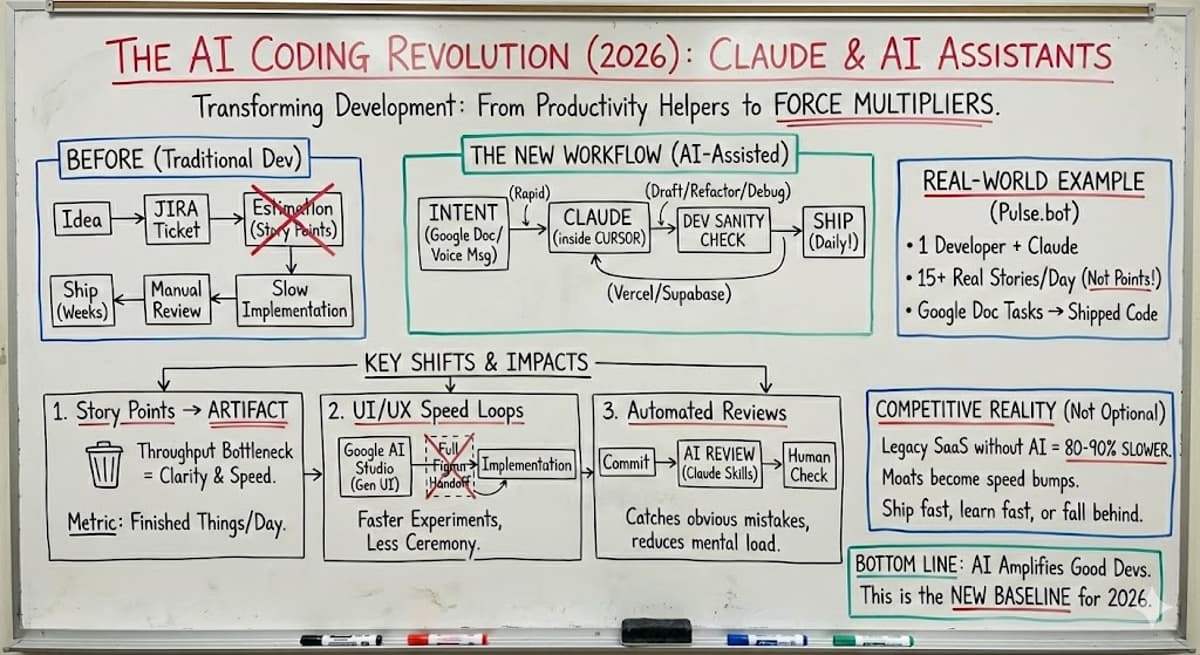
The rise of AI coding assistants marks a watershed moment for software engineering. Models like Claude Opus 4.5 combine natural‑language understanding with deep code reasoning, allowing developers to describe intent and receive production‑ready implementations in minutes. This capability erodes the friction points that once justified lengthy sprint planning, extensive documentation, and multi‑layered review cycles. By automating repetitive scaffolding, debugging, and even documentation, AI tools free engineers to focus on higher‑order problem solving, fundamentally shifting the value proposition of development talent.
In practice, the workflow has migrated from a document‑centric, point‑based system to an intent‑to‑code pipeline. Developers drop a brief description or screenshot, Claude drafts the solution, the engineer performs a quick sanity check, and the change ships instantly on platforms like Vercel with Supabase backing. This rapid loop eliminates the need for exhaustive UI handoffs in tools such as Figma for early‑stage features, and AI‑powered code reviews catch common errors before human reviewers engage. Even sprawling legacy codebases are being refactored at scale, as AI excels at consistent, pattern‑based transformations that humans typically avoid.
Strategically, the acceleration enabled by AI assistants translates directly into market advantage. Companies that can iterate five to ten times faster will outpace competitors on feature delivery, user experience, and pricing flexibility. The warning is clear: legacy SaaS firms that cling to traditional development tempos risk obsolescence within 24‑36 months. Early adoption—providing developers with unlimited AI inference, integrating voice‑driven task creation, and leveraging the most capable models—will become the baseline for competitive software development in 2026 and beyond.
The AI Coding Revolution: How Claude and AI Assistants Are Transforming Software Development in 2026
0
Comments
Want to join the conversation?
Loading comments...