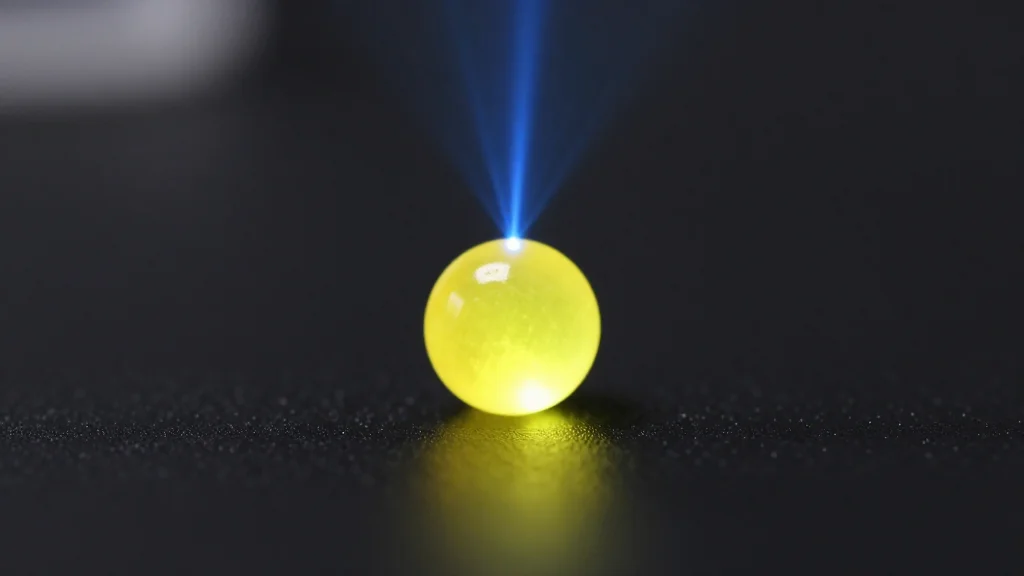
3D-Printed Glowing Ceramics Could Shrink Future Photonic Devices
Key Takeaways
- •Laser multiphoton 3D printing creates YAG:Ce microstructures.
- •Process yields single‑phase crystalline ceramic after pyrolysis.
- •Emission peak at 558 nm under 450 nm excitation confirmed.
- •Enables compact light sources for LEDs, sensors, and optical circuits.
- •Opens path to scalable micro‑photonics manufacturing.
Pulse Analysis
The demand for ever‑smaller photonic components has outpaced traditional manufacturing techniques, which struggle to produce three‑dimensional structures with both crystalline purity and sub‑micron resolution. Yttrium aluminum garnet doped with cerium (YAG:Ce) has been a workhorse in white LEDs and laser lighting because of its high quantum efficiency and thermal stability, yet shaping it into intricate micro‑architectures has required costly, multi‑step processes. The new laser‑driven multiphoton 3D nano‑printing approach sidesteps these limitations by turning a photosensitive sol‑gel into a solid ceramic in a single, mask‑less step, preserving the material’s optical properties while delivering nanometer‑scale detail.
The process begins with a resin containing 0–5 mol % Ce³⁺, which is selectively polymerized by a tightly focused femtosecond laser. Multiphoton absorption confines the reaction to the focal volume, enabling features far below the diffraction limit. Subsequent staged pyrolysis removes organics and induces crystallization, shrinking the part but retaining its geometry. The resulting micro‑structures exhibit a sharp emission band at 558 nm under 450 nm excitation, confirming that the single‑phase cubic YAG:Ce lattice survives the high‑temperature treatment. Compared with conventional sputtering or bulk sintering, this method offers unprecedented design freedom and material integrity.
From a commercial perspective, the ability to print functional, light‑emitting ceramics directly onto chips could reshape the supply chain for LEDs, on‑chip sensors, and integrated optical circuits. Designers can now embed miniature light sources where space and thermal budgets are tight, potentially lowering assembly costs and improving device reliability. Industries ranging from consumer electronics to aerospace stand to benefit, as the technology promises lower power consumption and longer lifetimes for illumination and detection systems. Future work will focus on scaling the technique, expanding the palette of luminescent dopants, and integrating multiple optical functions within a single printed component, paving the way for a new generation of micro‑photonics.
3D-printed glowing ceramics could shrink future photonic devices
Comments
Want to join the conversation?