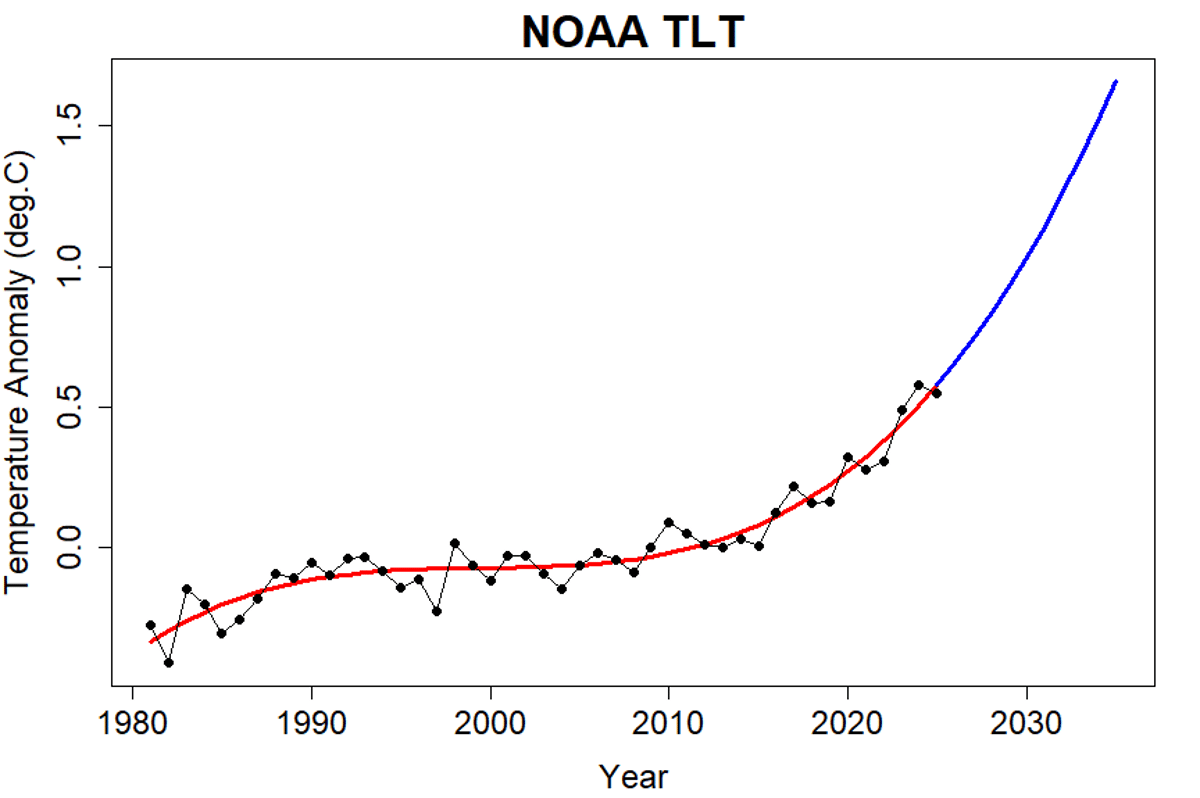

Key Takeaways
- •Preprint claims 0.5‑1.0 °C warming in next decade
- •Statistical significance only rejects linear‑trend null model
- •Cubic fit may fit past data but lacks physical basis
- •Higher‑order polynomials extrapolate poorly beyond observed range
- •Author expects ~0.33 °C per decade, hitting 1.5 °C by 2030
Pulse Analysis
The debate over accelerating global warming often hinges on how researchers treat noisy climate records. Recent work that strips ENSO and aerosol signals from lower‑troposphere temperature data suggests a dramatic post‑2015 surge, with acceleration rates that would add half to a full degree Celsius within ten years. While such numbers grab headlines, the statistical foundation matters: significance tests merely demonstrate that a simple linear trend cannot explain the data, not that a particular higher‑order model accurately captures the underlying physics. This distinction is essential for scientists, investors, and regulators who rely on robust projections to allocate resources and set emissions targets.
Polynomial fitting, especially cubic or higher orders, can closely trace a 45‑year temperature series but quickly becomes unreliable when projected forward. Autocorrelation in monthly observations, edge effects, and the lack of a mechanistic link between the fitted curve and climate drivers mean that extrapolations can diverge dramatically from reality. Climate modelers therefore prefer physically based simulations that incorporate greenhouse‑gas forcing, feedbacks, and ocean heat uptake, rather than purely statistical curves that may overstate near‑term warming.
For policymakers and businesses, the practical takeaway is to treat extreme acceleration scenarios with caution. A more tempered outlook—around 0.33 °C per decade—still signals crossing the 1.5 °C threshold by 2030 and the 2 °C limit by mid‑century, underscoring the urgency of mitigation and adaptation plans. Accurate risk modeling depends on transparent methodology, peer review, and an appreciation of statistical limits, ensuring that climate strategies are grounded in credible science rather than speculative spikes.
Acceleration in the lower troposphere
Comments
Want to join the conversation?