
Key Takeaways
- •Bouncing droplets reproduce quantized energy levels in a tabletop fluid system
- •Experiments emulate double-slit interference, Anderson localization, and spin‑½ behavior
- •Analogies extend to quantum field theory and entanglement-like correlations
- •Open‑source simulation code lets researchers explore droplet dynamics digitally
- •Low‑cost setup offers deterministic pilot‑wave insights without quantum hardware
Pulse Analysis
The resurgence of pilot‑wave experiments using bouncing droplets has captured attention across physics and technology circles. By vibrating a shallow oil bath, a droplet creates a self‑generated surface wave that guides its motion, mirroring the de Broglie‑Bohm interpretation of quantum particles. Researchers have documented a suite of quantum‑like phenomena—quantized orbital states, interference patterns through single and double slits, Anderson localization, and even spin‑½ analogues—demonstrating that deterministic wave‑particle coupling can reproduce effects traditionally thought exclusive to the quantum realm.
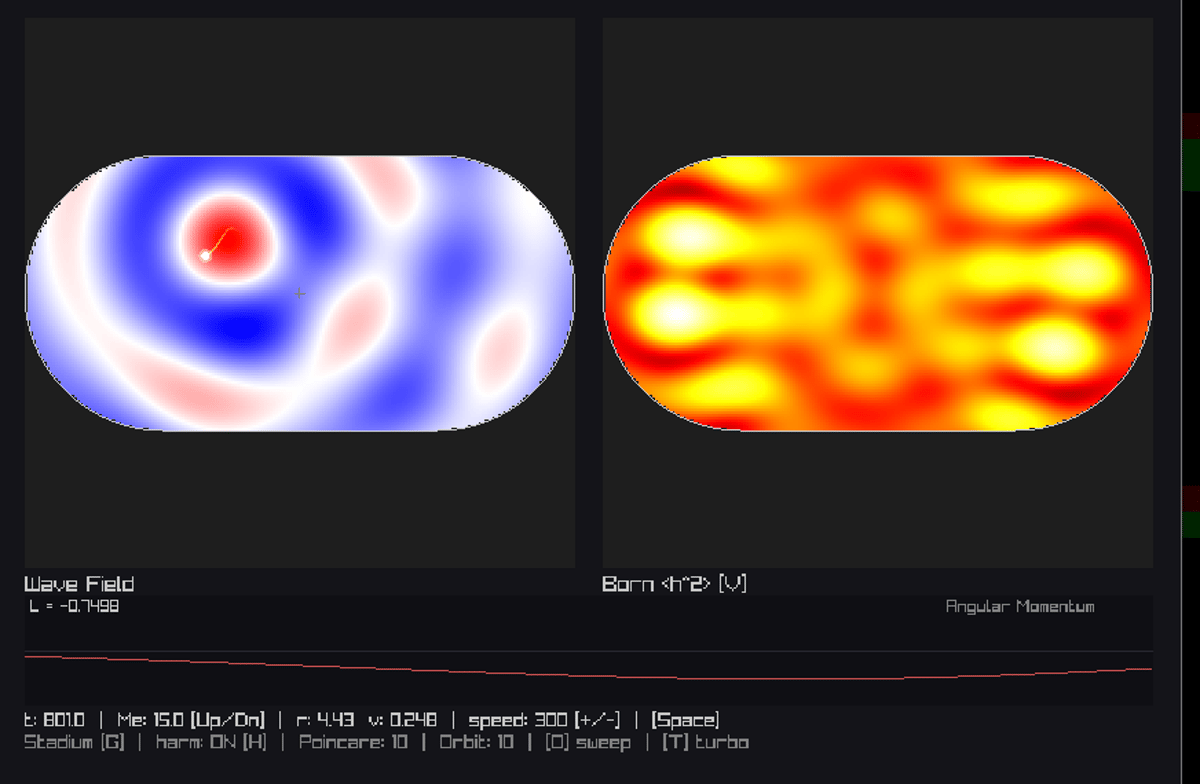
Beyond the laboratory, the community has embraced open‑source software that simulates these hydrodynamic walkers. The codebase includes simple Bessel‑function maps, more sophisticated Oza and Harmonic models, and even numerical solutions of the Schrödinger equation for comparison. By adjusting parameters such as geometry (G) and vibration amplitude (V), users can generate Poincaré sections, eigenmode visualizations, and statistical distributions that echo the Born rule. This digital toolkit lowers the barrier to entry, enabling educators and researchers to explore pilot‑wave dynamics without the expense of constructing oil‑bath rigs.
The broader implication is a fresh, tangible platform for probing deterministic alternatives to standard quantum mechanics. While limited to two dimensions and reliant on gravity‑aligned setups, the experiments provide a concrete playground for testing theoretical extensions, such as Khrennikov’s random‑field models or hydrodynamic analogues of quantum field theory. For the tech industry, the low‑cost, visual nature of these systems offers compelling outreach and training opportunities, while also inspiring novel analog computing concepts that could one day complement conventional quantum hardware.
Bouncing droplet “quantum mechanics”
Comments
Want to join the conversation?