Key Takeaways
- •Pressurized chamber prevents droplet coalescence via air film stability
- •Droplets exhibit paired "waltz" motions guided by surface waves
- •System displays quantum‑like statistical behavior without actual quantum particles
- •Wave‑mediated interactions enable richer collective dynamics than collisions
- •Findings could inspire novel microfluidic sensors and quantum analog experiments
Pulse Analysis
The phenomenon of “walking droplets”—liquid beads that bounce on a vertically vibrated bath—has fascinated physicists for over a decade because the droplets carry their own pilot wave, creating a macroscopic analogue of wave‑particle duality. Early experiments showed single droplets following straight orbits, while later work revealed orbital quantization and tunneling‑like behavior. By scaling the system to many interacting droplets, researchers can explore collective effects that mirror quantum statistics, offering a rare bridge between classical fluid dynamics and the probabilistic language of quantum mechanics.
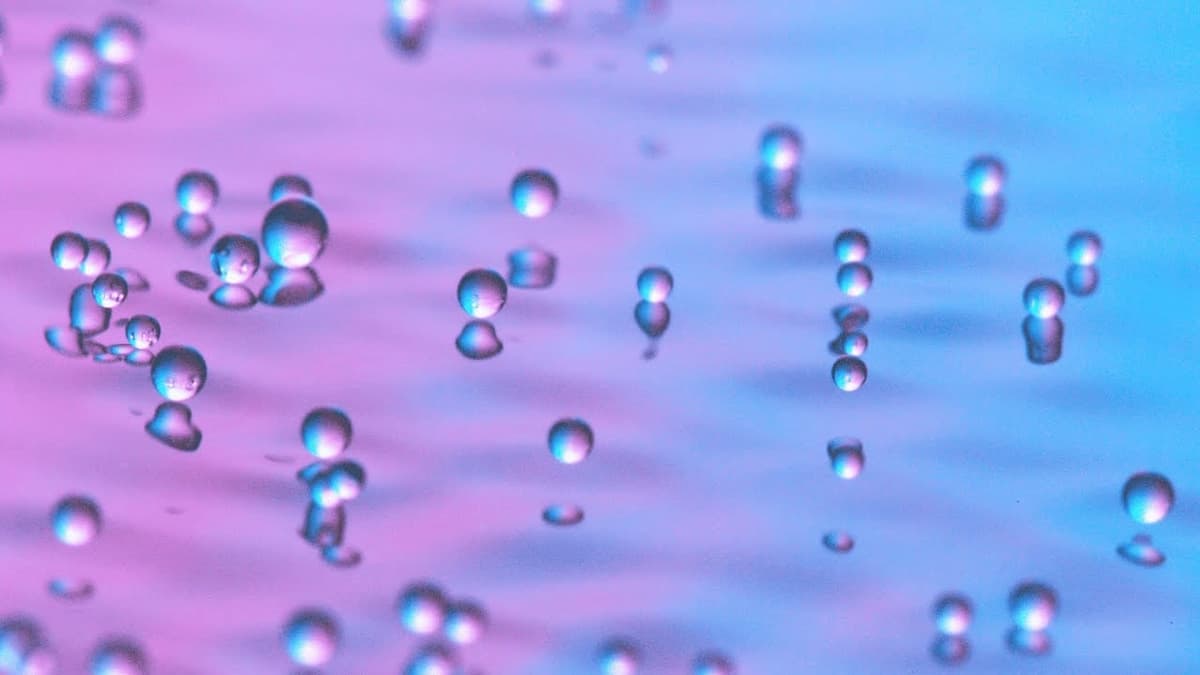
In the new study, the team placed the vibrating fluid inside a pressurized chamber, raising ambient pressure to thicken the air film that separates droplets during collisions. This simple tweak prevents coalescence, allowing droplets to interact repeatedly without merging. The resulting wave‑mediated forces cause droplets to synchronize into paired “waltz” motions, a pattern that would be impossible with purely hard‑sphere collisions. Statistical analysis of thousands of collision events revealed distributions matching those of quantum particles, suggesting that the underlying wave field imposes a probabilistic order on the ensemble.
The implications extend beyond academic curiosity. Engineers designing microfluidic platforms can borrow the non‑coalescing, wave‑guided principle to manipulate droplets with minimal contact, enabling high‑precision mixing or sorting without chemical surfactants. Moreover, the tabletop setup provides an inexpensive testbed for exploring quantum‑like phenomena, potentially accelerating research in quantum simulation and education. As the field moves toward integrating acoustic, optical, and fluidic control, the ability to program collective droplet behavior could spawn new sensors, actuators, and even unconventional computing architectures. Such versatility positions fluid‑based platforms as contenders for next‑generation analog processors.
Bouncing on a Wave
Comments
Want to join the conversation?