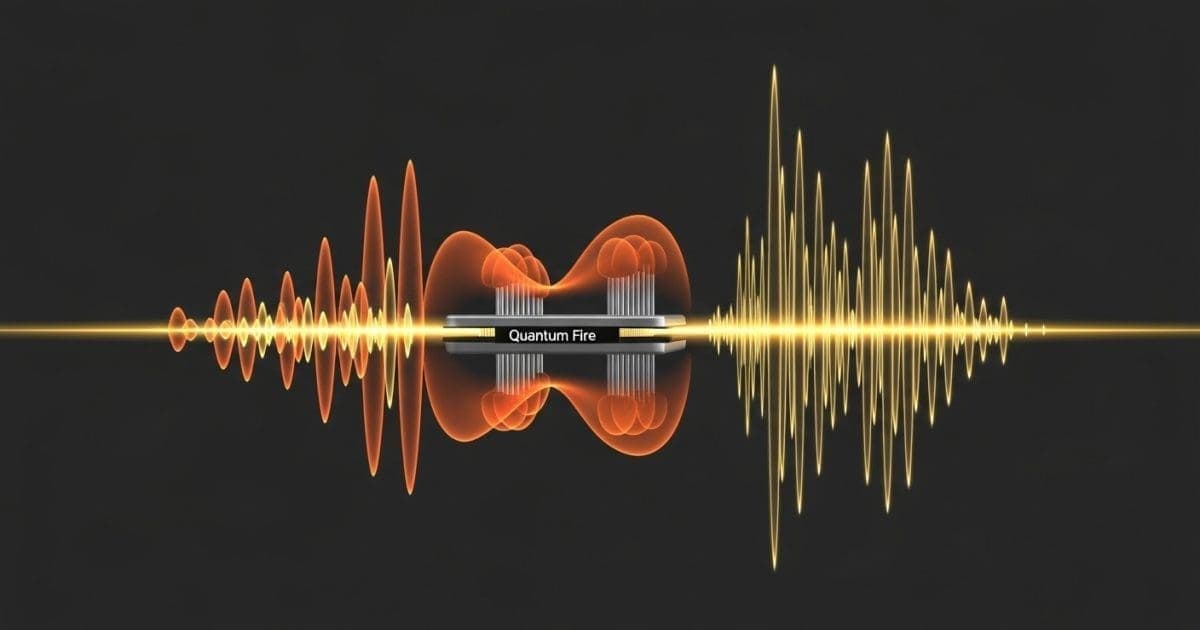
Broken Quantum Symmetry Restores Itself Faster with Greater Initial Disruption

Key Takeaways
- •Quantum Mpemba effect speeds symmetry restoration with larger initial disruption
- •Effect persists despite Hilbert‑space fragmentation from charge and dipole conservation
- •Replica tensor‑networks enable simulations up to 128 components, far beyond prior limits
- •Frozen Krylov sectors trap asymmetry, while active sectors drive accelerated relaxation
- •Higher‑order effect shows charge and dipole asymmetries relax on distinct timescales
Pulse Analysis
The quantum Mpemba effect, a counter‑intuitive analogue of the classic temperature‑based phenomenon, describes how a more severely disturbed quantum system can return to symmetry faster than a mildly perturbed one. By extending this concept to fragmented Hilbert spaces—where conservation laws split the state space into isolated Krylov sectors—the researchers demonstrate that the effect is not merely a theoretical curiosity but a robust feature of many‑body quantum dynamics. This insight reshapes expectations about equilibration in systems constrained by multiple symmetries, such as those relevant to quantum simulators and topological materials.
A technical breakthrough underpinning the study is the deployment of replica tensor‑network algorithms. Traditional exact‑diagonalization methods falter beyond a few dozen qubits due to exponential growth of the Hilbert space. The replica approach averages over multiple copies of the system, dramatically reducing computational overhead and allowing entanglement‑asymmetry metrics to be evaluated for lattices as large as L=128. This scale leap—from previous limits of ~20 components—provides unprecedented resolution of how charge and dipole conservation shape relaxation pathways, and it establishes a new benchmark for simulating fragmented quantum systems.
From an industry perspective, the findings have tangible implications for quantum technology development. Accelerated symmetry restoration in the “active” fragments could be harnessed to design error‑resilient quantum gates that self‑correct after large perturbations, while the persistence of asymmetry in frozen sectors highlights where decoherence mitigation must focus. Moreover, the higher‑order nature of the effect—different relaxation rates for charge versus dipole asymmetries—offers a nuanced lever for engineering material properties, such as tunable conductivity or exotic phases, through controlled symmetry breaking. Continued exploration of fragmented dynamics promises to accelerate the path toward scalable, fault‑tolerant quantum computers.
Broken Quantum Symmetry Restores Itself Faster with Greater Initial Disruption
Comments
Want to join the conversation?