Key Takeaways
- •Carbon adsorbates drive triboelectric charging of silica.
- •Removing surface carbon reverses charge polarity.
- •Identical oxides charge via differential contamination.
- •Acoustic levitation enables precise collision experiments.
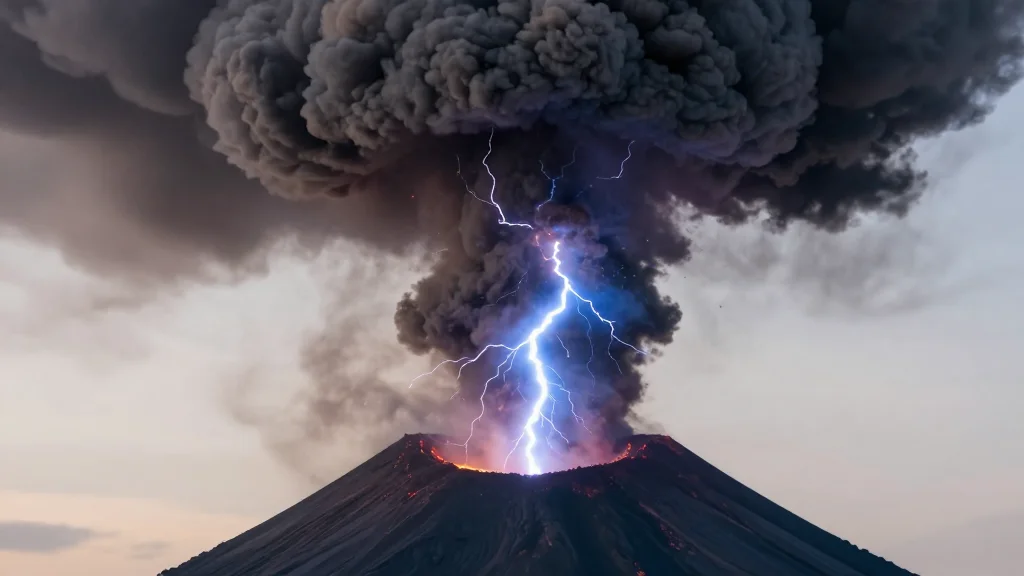
- •Findings clarify volcanic lightning generation mechanisms.
Pulse Analysis
The triboelectric effect—where contact between materials generates static electricity—has long puzzled researchers when identical insulators are involved. Traditional explanations rely on differences in material work functions, yet volcanic ash, composed largely of silica, still produces spectacular lightning. Recent work reveals that nanometer‑scale carbon films naturally adsorbed from the atmosphere create the necessary asymmetry. When one silica surface retains more carbon than its counterpart, electron transfer favors the cleaner surface, producing the observed charge separation that can ignite lightning within eruptive plumes.
To isolate this phenomenon, the research team employed acoustic levitation, a technique that suspends a 500‑micron silica sphere in a standing sound wave, allowing it to collide repeatedly with a matching plate without mechanical interference. By selectively cleaning one surface with plasma or chemical treatments, they could quantify charge buildup after each impact. The precise control afforded by levitation eliminated confounding variables such as frictional heating or surface roughness, demonstrating that even trace carbon layers—often invisible to standard microscopy—govern the direction and magnitude of charge transfer. This methodological breakthrough offers a reproducible platform for probing static electricity in other homogeneous material systems.
Beyond volcanic science, the findings have practical implications for industries where static discharge poses risks, such as semiconductor manufacturing, pharmaceutical powder handling, and aerospace fuel systems. Recognizing that surface contamination, rather than bulk material properties, can dominate charge dynamics enables engineers to design targeted cleaning protocols or intentional surface coatings to mitigate unwanted electrostatic events. Moreover, incorporating carbon‑adsorbate parameters into atmospheric models could improve forecasts of lightning‑related hazards during eruptions, aiding aviation safety and early‑warning systems. Future research will likely explore how humidity, temperature, and particle size interact with adsorbate‑driven charging, expanding our grasp of both natural and engineered electrostatic phenomena.
Building Triboelectric Charge
Comments
Want to join the conversation?