Key Takeaways
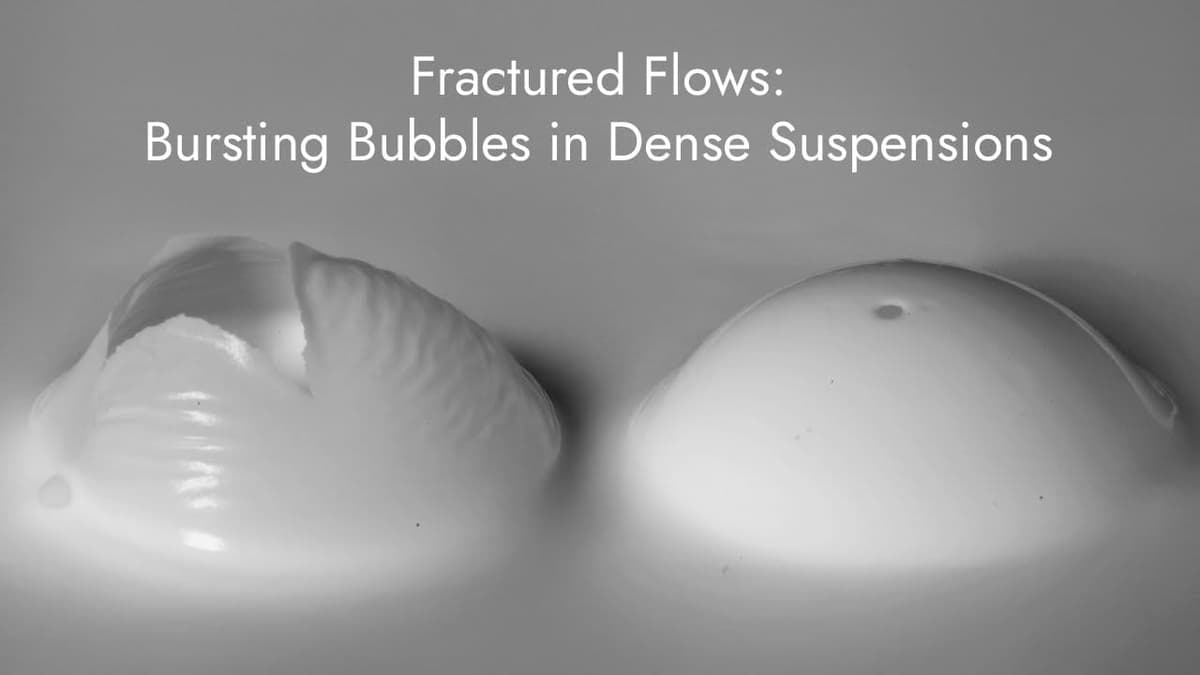
- •Oobleck bubbles fracture instead of retracting circularly
- •Increased cornstarch fraction reduces number of fracture fronts
- •Wrinkling occurs as broken film sinks back into fluid
- •Study highlights solid‑like response of shear‑thickening fluids
- •Findings inform design of impact‑absorbing materials and soft robotics
Pulse Analysis
When a soap bubble pops, surface tension pulls the film back into a perfect expanding circle. Oobleck, a classic non‑Newtonian fluid composed of cornstarch particles suspended in water, behaves strikingly differently. Upon bursting, its film does not retract smoothly; it tears, creates multiple fracture lines, and then wrinkles as the remnants sink, reflecting the material’s temporary solid‑like state under rapid stress. This contrast underscores how shear‑thickening fluids can switch from fluid to solid in milliseconds, a property that challenges traditional fluid dynamics models.
The research team generated bubbles by injecting air through oobleck mixtures with varying cornstarch mass fractions, ranging from 50% to 55%. High‑speed imaging revealed that higher particle concentrations produced fewer fracture fronts, indicating a more cohesive, albeit brittle, film. The wrinkling phase followed the initial fracture, showing a gradual relaxation back to a liquid state as the stresses dissipated. These observations provide quantitative benchmarks for rheologists studying the transition thresholds and energy dissipation pathways in shear‑thickening suspensions.
Beyond academic curiosity, the findings have practical implications. Industries that rely on impact mitigation—such as protective gear, automotive safety components, and soft‑robotic actuators—can leverage the predictable fracture and relaxation patterns of oobleck‑like materials. By tuning particle concentration, engineers can design composites that absorb shocks through controlled fracturing while maintaining recoverability. Future work may explore scaling these behaviors to larger systems or integrating them with smart materials for adaptive protection.
Bursting an Oobleck Bubble
Comments
Want to join the conversation?