Driven Quantum Systems Reveal Hidden Topological Changes Via Wave Packet Motion

Key Takeaways
- •Extended Hilbert space perturbation boosts CoM oscillations 1,883× over prior methods
- •Multi‑frequency CoM motion directly maps Floquet band structure and topology
- •Low‑frequency shifts and phase changes signal topological phase transitions
- •Approach works under strong driving where traditional Floquet‑Magnus fails
Pulse Analysis
Floquet systems—quantum materials subjected to periodic driving—have long promised exotic phases that static systems cannot host. Yet, conventional analytical tools like the Floquet‑Magnus expansion stumble when the drive frequency rivals or surpasses intrinsic energy gaps, producing unreliable predictions of band topology. Researchers therefore sought a more resilient framework capable of handling the full time‑dependent complexity without sacrificing precision.
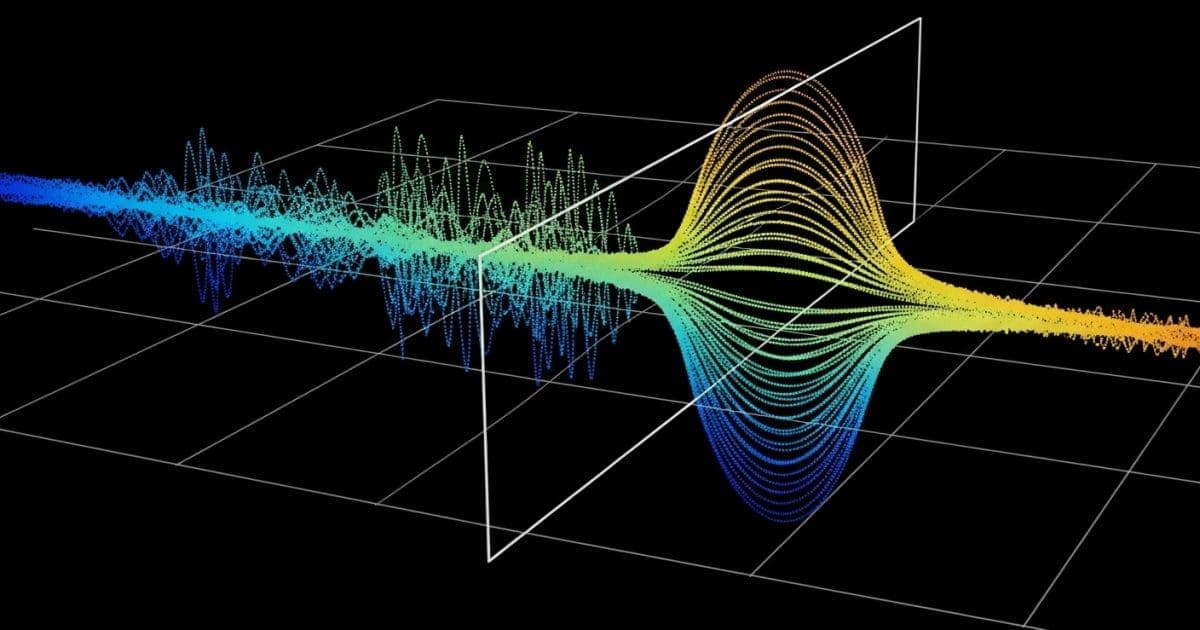
The new extended‑Hilbert‑space perturbation theory rewrites the Floquet‑Magnus series within a broader mathematical space that includes all possible quantum states. This reformulation yields centre‑of‑mass oscillations that are up to 1,883 times larger than previously observed, exposing a rich spectrum of multi‑frequency components. Crucially, these components act as fingerprints of the Floquet band structure: low‑frequency drifts and distinct phase shifts emerge precisely when band inversions signal a topological phase transition. By linking observable wave‑packet motion to abstract topological invariants, the method transforms a challenging spectroscopic problem into a tractable real‑space measurement.
For experimentalists, the breakthrough offers a straightforward diagnostic: monitor the average position of a wave packet as the system is driven, and read off topological changes from the resulting oscillation pattern. This could streamline the search for materials with protected edge states, a cornerstone for low‑dissipation electronics, quantum information processing, and spintronic devices. While the study currently validates the concept on the one‑dimensional driven Su‑Schrieffer‑Heeger model, the underlying theory is poised for extension to higher‑dimensional and more intricate platforms, potentially reshaping how the quantum materials community probes and engineers topological phenomena.
Driven Quantum Systems Reveal Hidden Topological Changes Via Wave Packet Motion
Comments
Want to join the conversation?