Key Takeaways
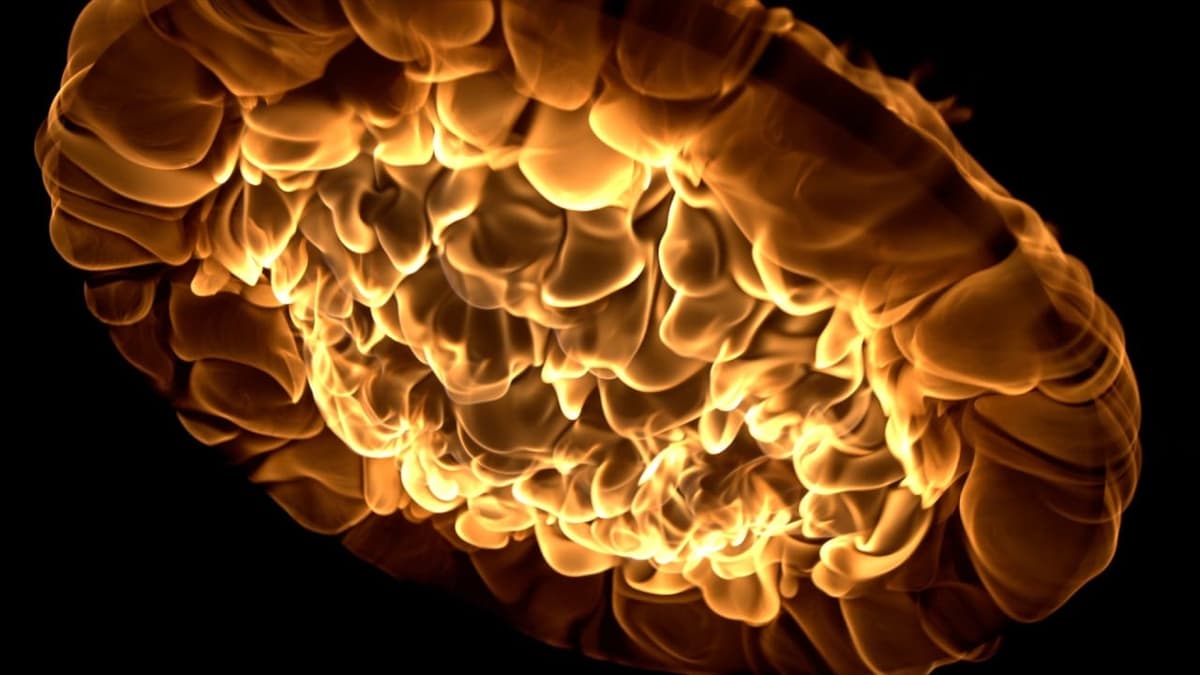
- •Upside‑down grill reverses normal buoyancy flow.
- •Flames appear more laminar than typical turbulence.
- •Cinnamon particles act as visible combustion tracers.
- •Slow‑motion capture reveals edge‑flow dynamics.
- •Technique offers new teaching tool for fluid dynamics.
Pulse Analysis
Viewing fire from an inverted perspective does more than produce eye‑catching footage; it challenges the conventional understanding of buoyancy‑driven flow. When a grill is flipped, hot gases cannot rise straight up, so they travel laterally and over the rim, creating a distinct edge‑flow pattern. This setup mirrors certain industrial scenarios—such as confined combustion chambers—where designers must manage heat and exhaust without relying on natural upward drafts. By capturing the phenomenon in ultra‑slow motion, the Slow Mo Guys provide a rare, high‑resolution window into these dynamics, valuable for fluid‑mechanics researchers and combustion engineers alike.
The video also highlights the transition between turbulent and laminar flame regimes. Most open‑air fires quickly become chaotic, yet the inverted grill produces a surprisingly smooth flame front, likely due to the constrained geometry and reduced vertical acceleration. Adding ground cinnamon introduces bright, traceable particles that follow the flow, acting as natural seeding for particle‑image velocimetry. This low‑cost tracer method offers a visual analogue to sophisticated laboratory techniques, allowing educators to demonstrate vortex formation, shear layers, and mixing processes without expensive equipment.
Beyond the scientific merits, the content serves as a powerful educational and marketing tool. High‑definition, slow‑motion visuals translate abstract concepts into intuitive experiences for students, engineers, and the general public. As brands and institutions seek engaging ways to communicate complex technology, such creative experiments illustrate how simple modifications—like flipping a grill—can unlock new insights and storytelling opportunities, reinforcing the importance of perspective in both science and media.
Fire From Below
Comments
Want to join the conversation?