Key Takeaways
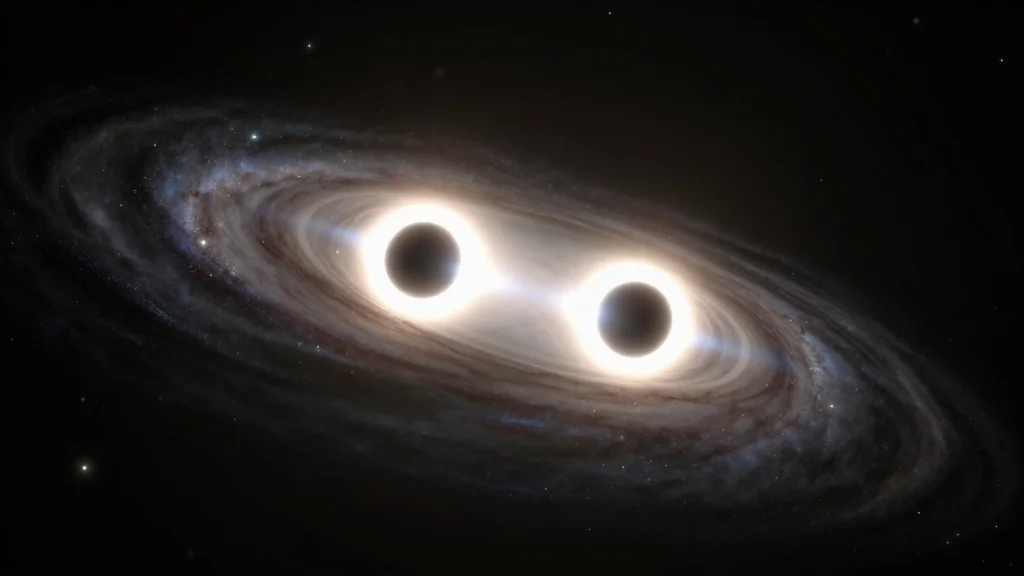
- •Direct evidence of two SMBHs in Markarian 501
- •Jets reveal orbital period of ~121 days
- •Potential merger within 100 years
- •Gravitational waves may be detectable via pulsar timing arrays
- •First close SMBH binary observed before coalescence
Pulse Analysis
The detection of a second jet in Markarian 501 stems from a painstaking 23‑year radio monitoring campaign that combined multiple frequencies and interferometric baselines. By tracking subtle shifts in jet orientation and brightness, researchers inferred a compact binary system whose orbital period is roughly 121 days. This tight dance places the black holes only a few hundred astronomical units apart—tiny on cosmic scales—yet massive enough (100 million‑to‑1 billion solar masses) to generate powerful relativistic jets that betray their presence.
Understanding how supermassive black holes grow is a cornerstone of modern astrophysics. While accretion of gas contributes, mergers between SMBHs are essential to reach the billions of solar masses observed in massive galaxies. The Markarian 501 binary offers a concrete example of this process in action, bridging the gap between galaxy collisions and the final coalescence phase that has remained largely theoretical. Moreover, the system is poised to emit low‑frequency gravitational waves, a signal that pulsar timing arrays are already hunting, potentially tying a specific source to the stochastic background detected in 2023.
Future observations will focus on indirect signatures rather than direct imaging, as even the Event Horizon Telescope lacks the resolution for such a tight pair. Next‑generation facilities like the Square Kilometre Array and space‑based interferometers could refine orbital parameters and capture the anticipated rise in gravitational‑wave frequency as the merger approaches. Watching a supermassive‑black‑hole merger unfold would revolutionize our grasp of galaxy evolution, test general relativity in extreme regimes, and sharpen the roadmap for multimessenger astronomy.
First close pair of supermassive black holes detected
Comments
Want to join the conversation?