Key Takeaways
- •New coordinate‑independent formula quantifies GW strain in expanding spacetime
- •Model uses two free‑falling masses and light travel‑time changes
- •Reduces to classic interferometer measurement in static background limit
- •Supports LISA and pulsar timing array searches for primordial GWs
Pulse Analysis
The 2015 discovery of gravitational waves opened a new observational window, but existing detectors have been calibrated for signals propagating through an almost empty, static spacetime. In cosmology, the background itself fluctuates, blurring the line between a wave and the medium it travels through. This ambiguity has hampered theoretical predictions for primordial signals that originated moments after the Big Bang, leaving a gap between abstract models and what instruments can actually record.
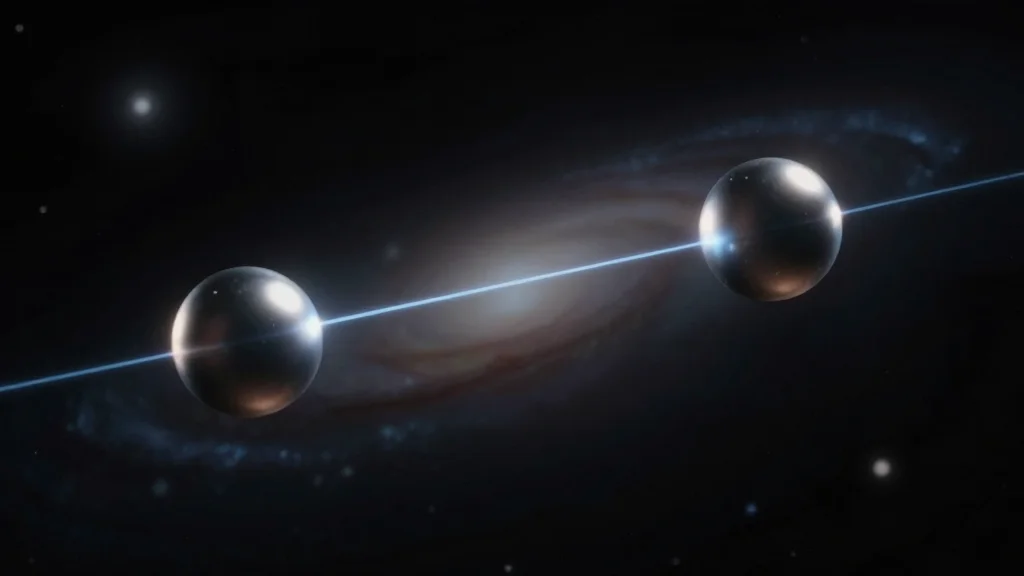
Domènech and his team tackled the problem by modeling a realistic detector: two test masses (or atomic clocks) connected by a light beam. By calculating how passing spacetime ripples alter the light's travel time, they derived an observable that remains invariant under coordinate transformations, extending to second‑order cosmic perturbations. The result is a clean, measurable quantity that experimentalists can compare against, eliminating the dependence on arbitrary mathematical frames that previously clouded predictions.
The practical payoff is significant. The new formalism seamlessly matches the standard interferometer response when the universe is quiet, yet it stays valid in the noisy, expanding early universe. This duality equips upcoming missions—such as the space‑based LISA observatory and global pulsar timing arrays—with a solid theoretical foundation to hunt for primordial gravitational waves. Detecting those ancient ripples could unlock details of inflation, phase transitions, and other high‑energy phenomena that shaped the cosmos, marking a transformative step for both astrophysics and fundamental physics.
Gravitational waves in a humming Universe
Comments
Want to join the conversation?