I-Tac Inverse Design Tunes 3D Printed Elastomers’ Optics And Haptics
Key Takeaways
- •i‑Tac integrates tactile and visual optimization in one inverse‑design loop
- •Works with DLP, PolyJet, and other vat photopolymerization printers
- •Uses characterize‑learn‑optimize pipeline to map material fractions to feel and look
- •Cuts prototype iteration time by replacing manual trial‑and‑error
- •Enables service bureaus to offer “feel‑matching” as a repeatable offering
Pulse Analysis
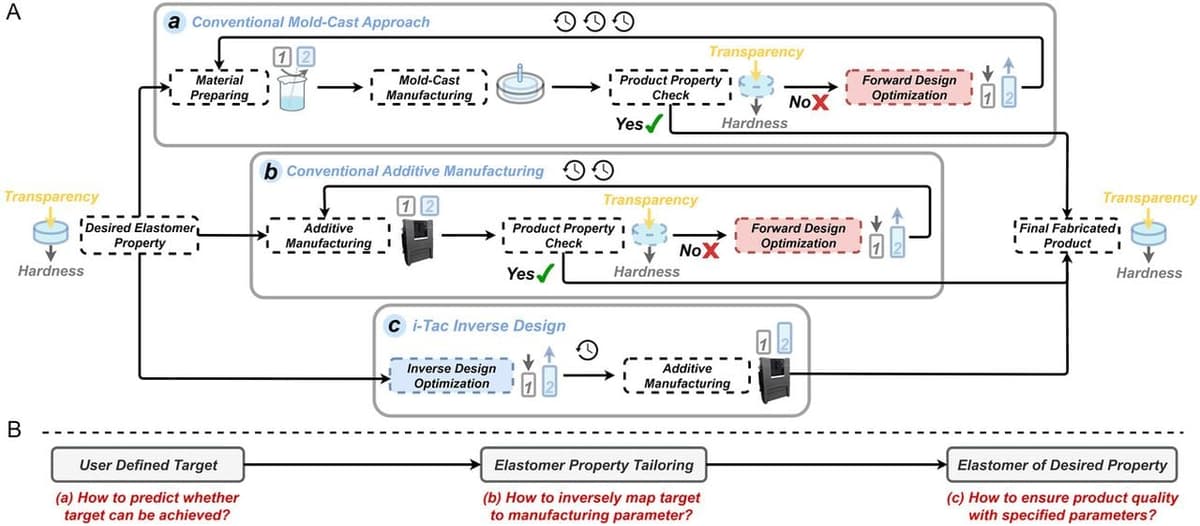
The i‑Tac workflow marks a shift in additive manufacturing from single‑property optimization to true multi‑objective inverse design. Traditional digital‑material pipelines let engineers adjust stiffness, color, or transparency in isolation, leaving the complex interplay between haptics and optics to costly trial‑and‑error. i‑Tac addresses this gap by first characterizing a broad set of elastomeric mixtures, then training a differentiable model that predicts both force‑displacement behavior and optical metrics such as CIE Lab color and haze. An optimizer subsequently searches the design space for the exact combination that satisfies a designer’s feel and visual specifications.
For product development teams, the practical upside is substantial. The iterative loop that once required dozens of printed prototypes can now be replaced by a single computational run, slashing both time‑to‑prototype and resin consumption. Because the output is a print‑ready voxel map, it integrates seamlessly with existing slicing software on DLP, PolyJet, or inkjet multi‑material printers. Service bureaus could package “feel‑matching” as a repeatable offering, allowing brands to replicate the tactile signature of a flagship product across new form factors without re‑engineering the material from scratch.
The broader market implication is a acceleration of soft‑touch product innovation across consumer electronics, automotive interiors, and personalized medical models. Companies like Carbon and Stratasys have already invested in programmable lattices and digital‑material libraries; i‑Tac’s ability to co‑optimize optics and haptics gives them a competitive edge in applications where appearance and grip are equally critical. As more designers adopt inverse‑design tools, we can expect a wave of aesthetically refined, ergonomically tuned 3D‑printed parts that were previously too expensive or time‑intensive to produce.
i-Tac Inverse Design Tunes 3D Printed Elastomers’ Optics And Haptics
Comments
Want to join the conversation?