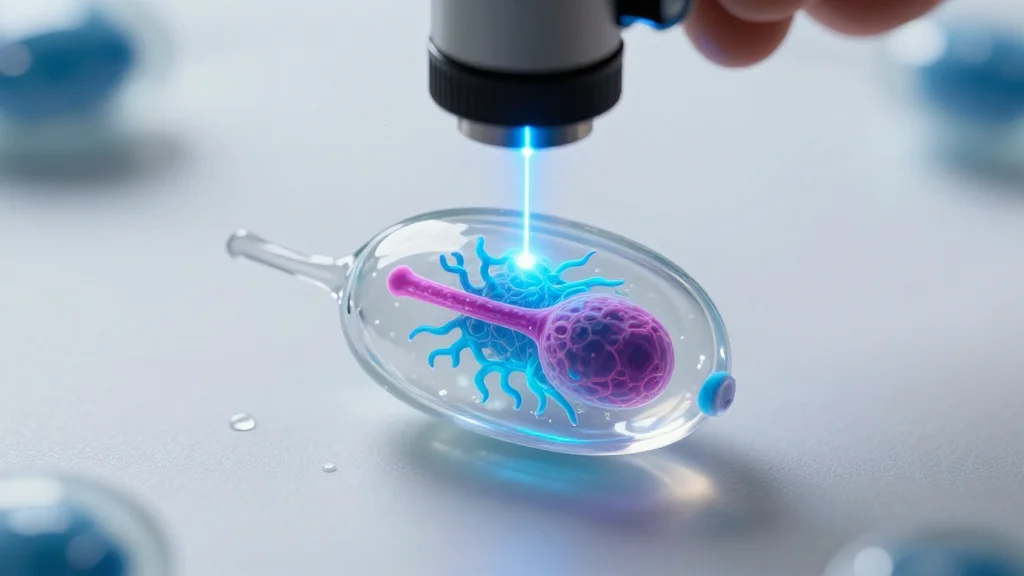
Laser Focus: Controlled Formation of Protein Networks
Key Takeaways
- •Focused laser creates protein fiber networks without chemical modification.
- •Near‑infrared optical force aligns proteins at laser focal point.
- •Resulting networks mimic cytoskeletal dynamics like translation and rotation.
- •Technique enables non‑invasive studies of cell division, migration, adhesion.
- •Potential for protein‑based actuators in soft robotics and bio‑machines.
Pulse Analysis
The cytoskeleton—a mesh of actin, microtubules and intermediate filaments—governs cell shape, motility and division. Traditional in‑vitro models rely on self‑assembly or photochemical cross‑linking, both of which either lack spatial control or demand covalent modifications that can alter protein activity. Consequently, researchers have struggled to recreate the highly ordered yet dynamic architecture of native networks, limiting the fidelity of mechanistic studies and drug‑screening assays. A method that can sculpt protein fibers with precision while leaving their biochemistry intact has long been a missing piece.
The Osaka‑Saitama team leveraged the optical gradient force of a tightly focused near‑infrared laser to draw individual protein molecules into a focal hotspot, where they aggregate into continuous fibers. Because the wavelength lies outside the visible spectrum, it does not interfere with standard fluorescence markers, enabling simultaneous imaging and manipulation. The resulting assemblies display motions—linear translation and flagella‑like rotation—that mirror those of living cytoskeletal tracks, confirming that the laser‑induced structures retain functional dynamics.
Importantly, the process avoids any chemical tagging, preserving native protein conformations. Beyond basic cell biology, this laser‑driven fabrication could accelerate discovery pipelines that depend on accurate cytoskeletal models, such as high‑throughput screens for anti‑cancer compounds targeting mitosis. In the engineering realm, the ability to program protein‑based actuators with micron‑scale precision suggests new pathways for soft‑robotic muscles and bio‑hybrid devices. Future work will likely explore scaling the technique to three‑dimensional tissue constructs and integrating it with microfluidic platforms, turning a laboratory curiosity into a versatile tool for both life sciences and biomimetic manufacturing.
Laser focus: controlled formation of protein networks
Comments
Want to join the conversation?