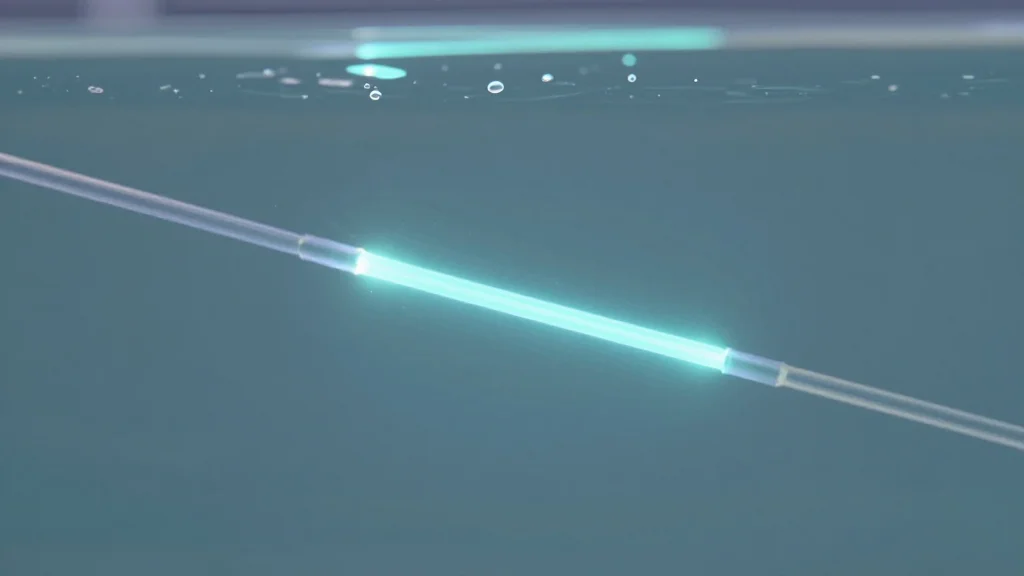
Light-Induced Drag Reveals New Way to Control Nanoscale Motion
Key Takeaways
- •Light adds drag to fluorescent carbon nanotubes in water
- •Diffusion slows proportionally to light intensity via exciton‑water coupling
- •Defective nanotubes lacking fast excitons show no light‑induced friction
- •THz spectroscopy confirms real‑time momentum transfer at solid‑liquid interface
- •Quantum friction could enable light‑controlled nanoscale transport devices
Pulse Analysis
The observation of light‑induced quantum friction challenges the conventional view that photons only impart kinetic energy or heat to particles. At the nanoscale, where surface forces dominate, the ability of an electronic excitation to act as a viscous brake reveals a hybrid solid‑liquid interaction that bridges quantum optics and fluid dynamics. This insight builds on decades of research into Casimir forces and non‑contact friction, but uniquely demonstrates a tunable, reversible effect that can be switched on with modest visible light.
In the Bochum study, researchers combined high‑resolution microscopy with terahertz (THz) spectroscopy to capture the instantaneous coupling between excitons in carbon nanotubes and the surrounding water. Atomistic simulations showed that fluctuating dipoles of the excited electrons generate a tiny yet measurable momentum exchange, effectively increasing the local viscosity. Crucially, nanotubes engineered with exciton‑blocking defects did not exhibit the slowdown, confirming that rapid exciton migration is the key driver. This experimental validation provides a rare window into solvation dynamics, highlighting water as an active participant rather than a passive medium.
The practical implications are far‑reaching. Light‑controlled friction could enable on‑demand steering of nanocarriers in biomedical applications, where precise delivery timing is critical. It also suggests new designs for nanofluidic circuits that use optical signals to regulate flow without mechanical parts. As the field moves toward integrating photonic control with nanoscale mechanics, the ability to modulate interfacial drag may become a cornerstone technology for next‑generation sensors, actuators, and energy‑harvesting devices. Continued exploration of material platforms and excitation wavelengths will determine how broadly this quantum friction can be harnessed across industries.
Light-induced drag reveals new way to control nanoscale motion
Comments
Want to join the conversation?