Key Takeaways
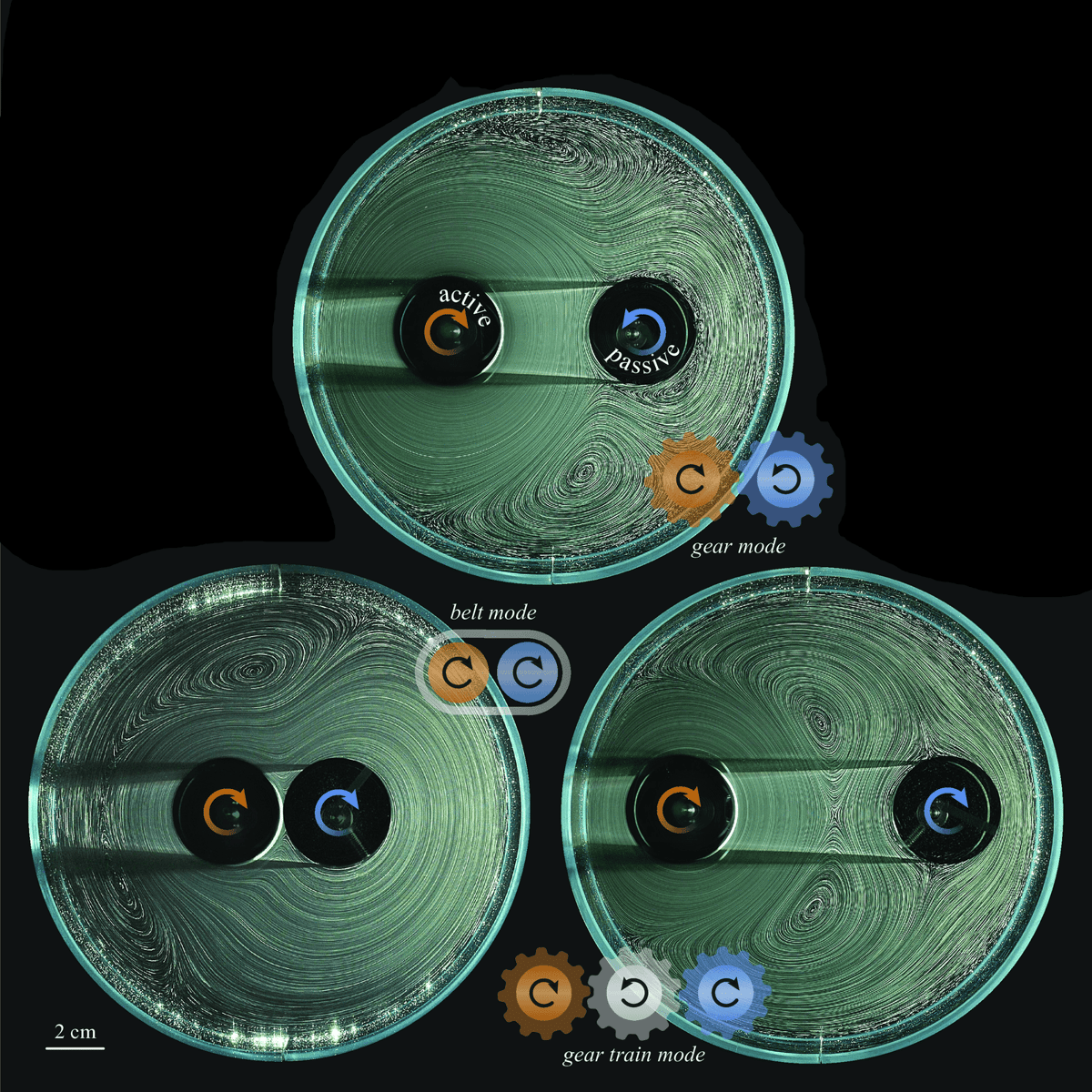
- •Active rotor drives passive one via shear‑induced torque
- •Close spacing causes co‑rotation, mimicking belt‑linked gears
- •Moderate gap produces opposite rotation due to inner‑side shear
- •Wide gap enables virtual gear coupling through intervening fluid
Pulse Analysis
The concept of using fluids to convey rotational motion dates back to early studies of vortex‑induced forces, but practical implementations have been limited. By immersing an active and a passive rotor in a viscous water‑glycerin mixture, the research team created a controllable platform where fluid shear alone can transmit torque. This approach sidesteps the friction, lubrication, and alignment challenges that plague miniature gear trains, making it especially attractive for applications where traditional components cannot be fabricated or maintained.
In the experimental setup, the rotors are positioned at varying distances within a cylindrical chamber. When the gap is narrow, the high‑shear layer on the outer edge of the passive rotor pulls it into the same rotational direction as the active rotor, effectively acting like a belt drive. At a moderate separation, the shear on the inner side dominates, reversing the passive rotor’s spin. At larger separations, the fluid between the rotors behaves as a distributed gear, allowing both to co‑rotate without direct contact. High‑resolution particle‑image velocimetry maps confirm that the torque originates from viscous coupling rather than pressure differentials.
These findings open pathways for designing fluidic power transmission systems in micro‑electromechanical devices, biomedical pumps, and soft‑robotic actuators. Engineers can now envision torque‑sharing networks that are self‑lubricating, adaptable to variable loads, and capable of operating in sealed environments where conventional gears would corrode or jam. Future work will likely focus on scaling the principle to arrays of rotors, optimizing fluid rheology for higher efficiency, and integrating control schemes that modulate active rotor speed to fine‑tune power distribution across complex fluidic gear trains.
Liquid Pulleys and Gears
Comments
Want to join the conversation?