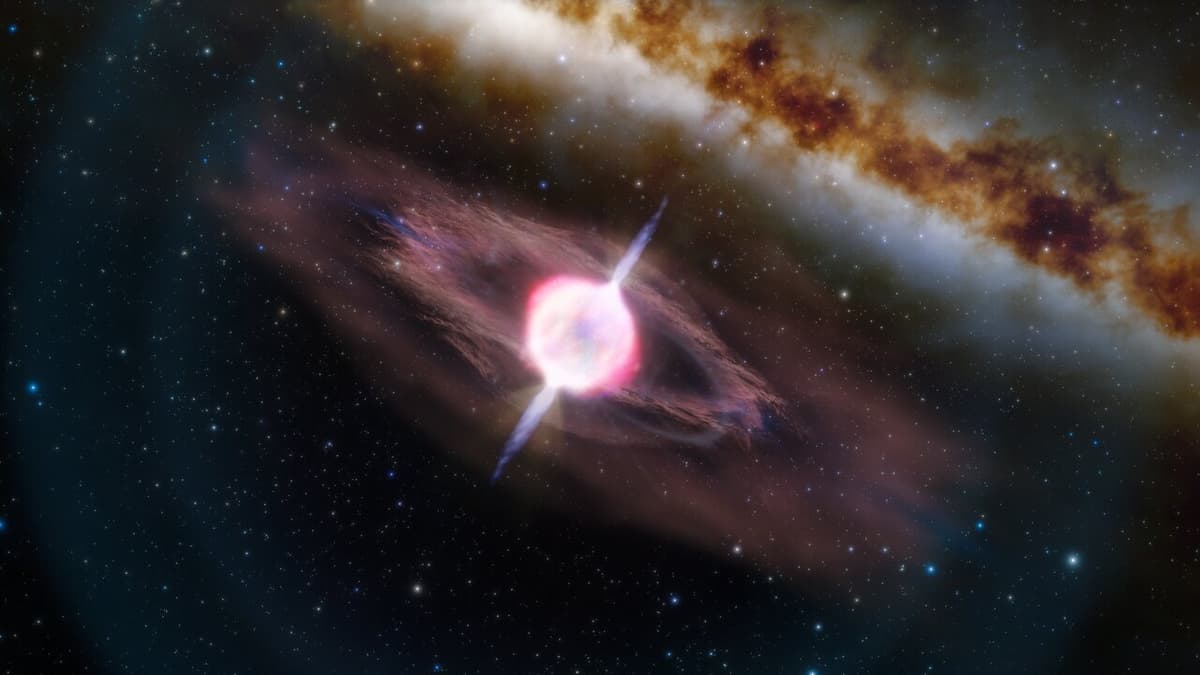
Live Fast Die Immediately – Spinning Black Holes in Collapsars
Key Takeaways
- •Slow-spinning black holes accrete mass faster, weakening jet power
- •Neutrino cooling does not directly reduce black hole spin
- •Magnetic torque, not neutrinos, drives spin-down in magnetically arrested disks
- •Density profile of collapsar influences accretion rate and neutrino emission efficiency
Pulse Analysis
The new simulations mark a milestone in collapsar research by integrating three‑dimensional general‑relativistic magnetohydrodynamics with detailed neutrino transport. Earlier models either omitted neutrinos or relied on simplified cooling approximations, limiting insight into how energy loss channels affect black‑hole dynamics. By capturing neutrino emission alongside magnetic stresses, the study reveals that while neutrinos siphon thermal energy, they do not exert a significant torque on the black hole itself. Instead, the magnetic field—when in a magnetically arrested disk (MAD) configuration—remains the primary driver of spin evolution, extracting angular momentum and powering relativistic jets.
A key discovery is the sensitivity of jet stability to the black‑hole spin rate. Slow‑spinning holes draw in matter more aggressively, producing denser accretion flows that can destabilize the MAD state. The resulting jets become bent or intermittent, which would manifest as fainter or irregular gamma‑ray bursts. Conversely, rapidly rotating black holes sustain strong, collimated jets, aligning with the brightest long‑duration GRBs observed. This spin‑dependent jet behavior offers a diagnostic tool: observed GRB luminosities and variability may be back‑projected to infer the progenitor’s spin and magnetic environment.
The implications extend to multimessenger astronomy. Collapsars are candidate sources of both high‑energy photons and the black‑hole binaries that later merge, emitting gravitational waves. By linking spin evolution, accretion physics, and jet output, the simulations provide a framework to cross‑reference GRB catalogs with gravitational‑wave event rates. Future observations—especially with next‑generation neutrino detectors and high‑resolution X‑ray telescopes—can test these predictions, refining our picture of how massive stars end their lives and seed the universe with energetic transients.
Live fast die immediately – spinning black holes in collapsars
Comments
Want to join the conversation?