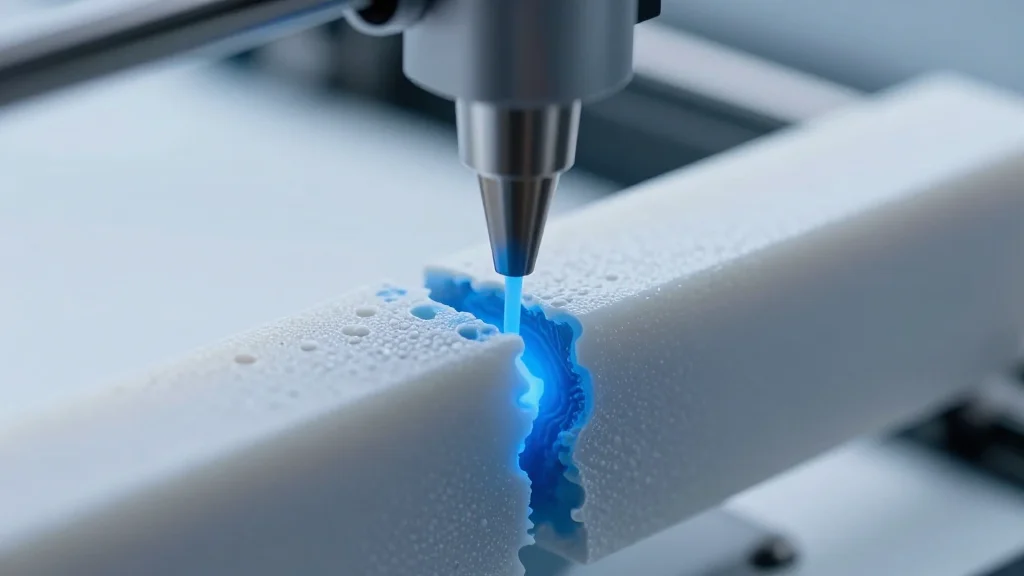
LLNL Combines Machine Learning and 3D Printing for Shockwave Control Experiments
Key Takeaways
- •AI algorithm identified void geometry that dampens Richtmyer‑Meshkov instability
- •3D‑printed polymer‑gelatin target experimentally reduced shock‑induced jetting
- •Technique offers a low‑cost testbed for inertial confinement fusion research
- •Void‑based design could improve fill tubes and material interfaces in ICF capsules
- •Approach may benefit shock‑wave applications in oil‑gas extraction and defense
Pulse Analysis
The Richtmyer‑Meshkov (RM) instability has long plagued high‑energy density physics, especially inertial confinement fusion (ICF), where tiny perturbations at material interfaces amplify into destructive jets that break capsule symmetry. Traditional mitigation relies on material selection or geometric tweaks, but these approaches lack the precision to counteract the rapid, nonlinear growth of the instability. Recent advances in artificial intelligence and high‑performance computing enable researchers to explore vast design spaces, identifying micro‑scale features—such as voids—that can manipulate shock dynamics in ways conventional intuition cannot predict.
In the new study, LLNL scientists paired a machine‑learning optimizer with a polymer 3D printer to fabricate a gelatin‑filled target containing a lattice of engineered cavities. When a high‑current pulse vaporized a copper strip, the resulting shock wave encountered the voids, which fragmented the pressure front into staggered pulses. High‑speed diagnostics showed a marked reduction in jet formation compared with a flat‑surface control, confirming that the AI‑generated geometry creates a secondary pressure wave that actively suppresses RM‑driven jetting. The experimental workflow—simulation, rapid additive manufacturing, and bench‑scale testing—demonstrates a practical route from computational concept to physical validation.
Beyond ICF, the ability to tailor shock‑wave propagation has implications for sectors ranging from oil‑gas drilling, where controlled blasts improve fracture efficiency, to defense, where armor and explosive design benefit from precise wave shaping. By providing a low‑cost, repeatable platform to study and mitigate shock‑induced instabilities, the approach could accelerate the development of more symmetric fusion capsules, enhance fill‑tube performance, and inspire new materials engineering strategies across high‑impact industries.
LLNL Combines Machine Learning and 3D Printing for Shockwave Control Experiments
Comments
Want to join the conversation?