LPBF Aluminum Alloy Adds Heat Resistance And Ductility
Key Takeaways
- •All‑in‑one LPBF alloy stays strong at 400 °C
- •Nanoprecipitate network forms during build, no aging needed
- •Uses only common elements, no rare‑earths required
- •Room‑temp yield strength ~440 MPa, 7% elongation
- •Creep rates at 400 °C lower than existing AM Al
Pulse Analysis
Additive manufacturing has long struggled to produce aluminum parts that survive elevated temperatures. Conventional printable alloys such as AlSi10Mg lose strength above 250 °C and suffer rapid creep at 300‑400 °C, forcing designers to resort to expensive alloying elements or complex heat‑treatment cycles. This limitation has constrained the use of lightweight aluminum in high‑heat aerospace, marine and automotive applications, where thermal stability is as critical as weight savings.
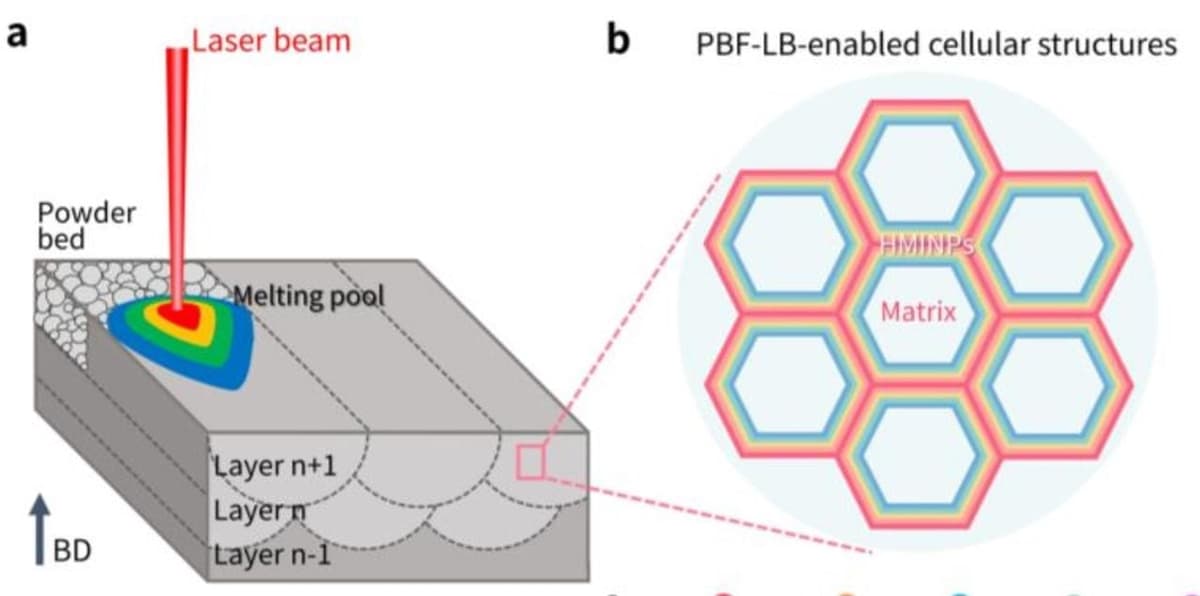
The breakthrough reported in Nature Communications leverages the inherent thermal gradients of LPBF to create a self‑assembled nanostructure. By enriching cell walls with high‑solubility silicon and slow‑diffusing transition metals, a continuous 60‑nm‑thick multicomponent intermetallic network forms in‑situ, acting as a barrier to grain coarsening and dislocation motion. The resulting microstructure—300‑400 nm cells bounded by a robust nanoprecipitate skeleton—delivers a room‑temperature yield strength of about 440 MPa and retains over 100 MPa tensile strength after 168 hours at 400 °C, all without any post‑build aging.
The commercial implications are significant. Industries that demand hot, lightweight components can now consider LPBF aluminum for engine brackets, turbine housings, and marine propulsion parts, reducing part count and material waste while avoiding the cost premium of scandium‑ or silver‑based alloys. Early demonstrations in aerospace and marine sectors suggest rapid adoption, especially as powder costs remain comparable to existing AlSi10Mg feedstocks. Continued validation of long‑term creep behavior and scaling of production will likely cement this alloy as a new standard for high‑temperature additive manufacturing.
LPBF Aluminum Alloy Adds Heat Resistance And Ductility
Comments
Want to join the conversation?