Key Takeaways
- •Magnetic fields expel gas, carrying away angular momentum from protostars.
- •Simulations with magnetic fields produce tighter binary separations; zero field widens gap.
- •Findings align with observed early binary star formation in Milky Way.
- •Process may also drive inspiral of binary black holes in gas‑rich galaxies.
- •ATERUI III supercomputer enabled high‑resolution modeling of circumbinary disks.
Pulse Analysis
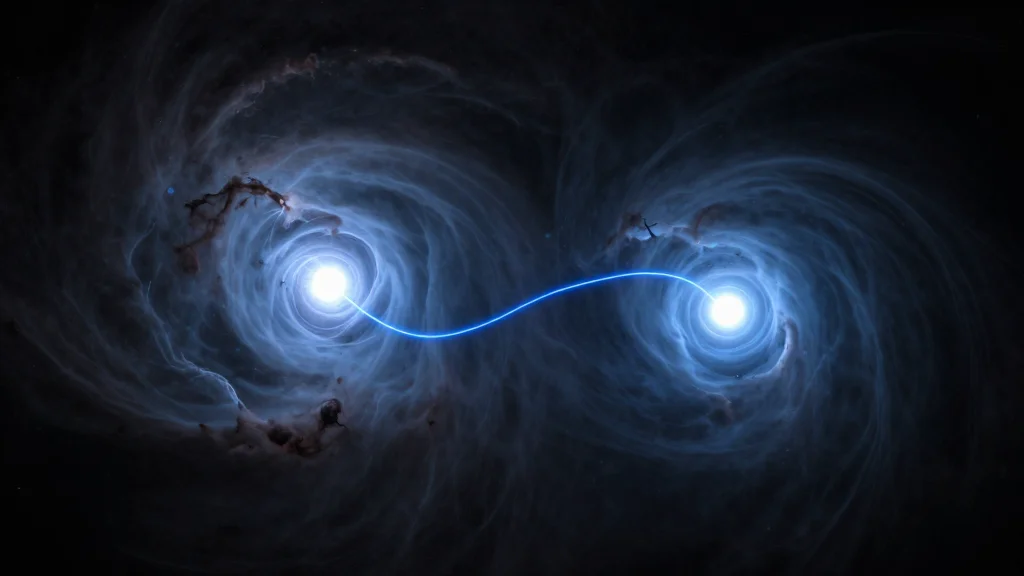
The formation of binary stars has long puzzled astronomers because collapsing gas clouds must shed a huge amount of angular momentum to allow two protostars to bind. Traditional models relied on turbulent viscosity or gravitational torques, yet observations of young binaries in the Milky Way suggest they coalesce far faster than those mechanisms predict. By leveraging the ATERUI III and ATERUI II supercomputers, researchers modeled the interaction between a circumbinary disc and an ambient magnetic field. The simulations show that magnetically driven outflows efficiently remove angular momentum, pulling the protostars together within a few hundred thousand years—timescales consistent with infrared surveys of star‑forming regions.
These results bridge the gap between theory and observation, confirming that magnetic braking is not a peripheral effect but a dominant driver of early binary assembly. The study also clarifies why binary fractions remain high across stellar masses: magnetic fields are ubiquitous in molecular clouds, providing a universal mechanism that operates regardless of local density variations. Consequently, the findings reshape population‑synthesis models, prompting revisions to the predicted rates of binary‑related phenomena such as Type Ia supernovae and gravitational‑wave sources originating from stellar‑mass mergers.
Beyond protostars, the same physics may govern the inspiral of massive binary black holes embedded in the dense, gas‑rich cores of newly merged galaxies. If magnetic fields can extract angular momentum from the surrounding accretion flow, they could shorten the otherwise prohibitive merger timescales, facilitating the rapid growth of supermassive black holes observed at high redshift. While direct simulations of such black‑hole pairs remain computationally demanding, the present work offers a compelling framework for future studies and underscores the broader relevance of magnetohydrodynamic processes in cosmic structure formation.
Magnetic field helps binary star systems form
Comments
Want to join the conversation?