
Key Takeaways
- •West and Southwest March temps broke records by over 4°F
- •All seven Colorado River basin states hit hottest March on record
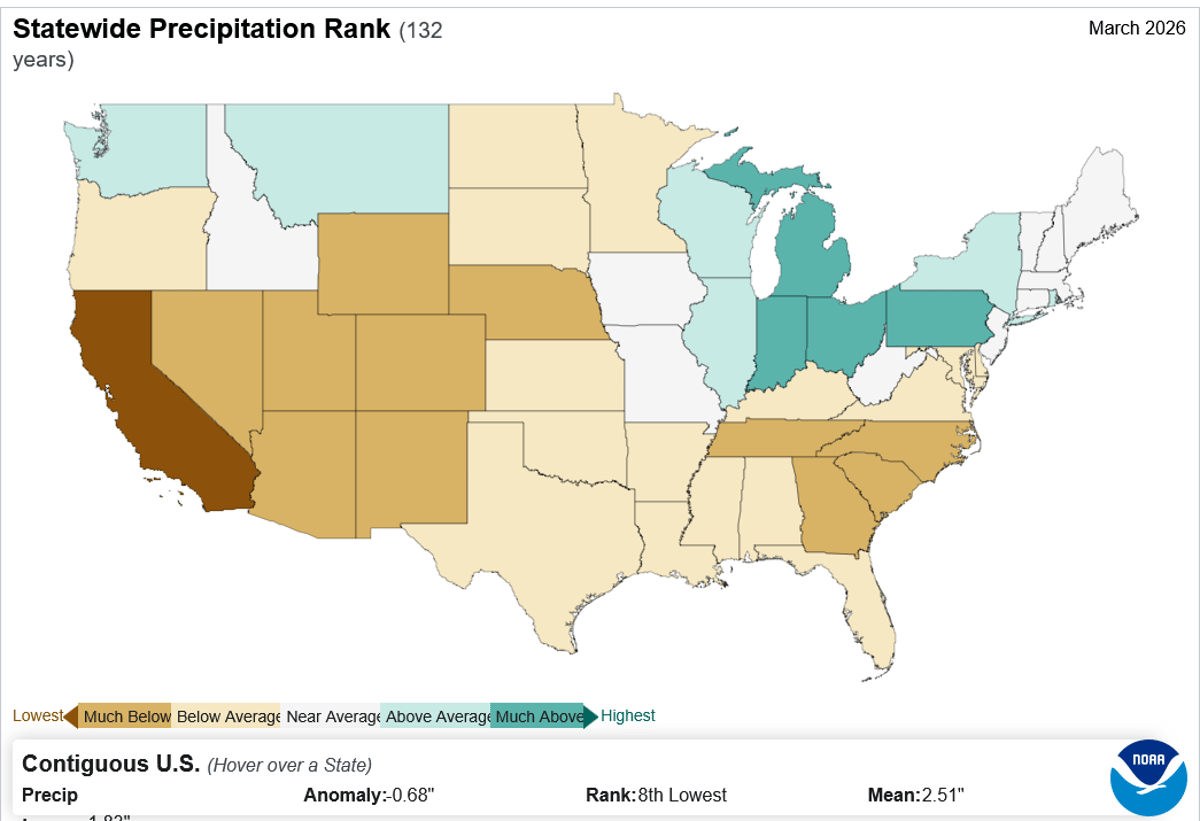
- •Snowpack near zero; precipitation “much below average” across region
- •Reservoirs Lake Mead and Powell already at critically low levels
- •Early heat raises wildfire risk and long‑term water scarcity
Pulse Analysis
The March 2026 temperature spike is more than a statistical footnote; it underscores a accelerating warming trend that is reshaping seasonal climate baselines across the United States. While the national average nudged past the 2012 record by a modest 0.45 °F, the regional disparity is stark. The West and Southwest experienced temperature anomalies exceeding four degrees Fahrenheit, a magnitude rarely seen in the 126‑year record. Such anomalies are consistent with climate models that predict amplified warming in arid and semi‑arid zones, where reduced cloud cover and higher solar insolation intensify heat accumulation during spring months.
Water managers are now confronting a perfect storm of climate stressors. The seven states that share the Colorado River—Wyoming, Colorado, Utah, Nevada, California, Arizona, and New Mexico—each recorded their hottest March, eroding the snowpack that traditionally feeds the river’s flow. Coupled with "much below average" precipitation, reservoirs like Lake Mead and Lake Powell have plunged toward critical thresholds, jeopardizing water allocations for agriculture, municipal use, and hydroelectric power. The loss of snowpack also diminishes natural flood control, increasing downstream flood risk when the first heavy rains arrive later in the year.
Beyond immediate water concerns, the early heat wave amplifies wildfire risk, threatening communities, infrastructure, and air quality across the western corridor. Economically, reduced water availability can curtail crop yields, strain energy production, and inflate insurance costs. Policymakers must therefore accelerate adaptive strategies—such as water‑rights reforms, investment in desalination, and forest‑management practices—to buffer against a climate that is delivering hotter, drier springs more frequently. The March 2026 data point serves as an early warning that the window for proactive mitigation is narrowing, and the cost of inaction will be borne by both the environment and the economy.
March 2026: Climate in the USA
Comments
Want to join the conversation?