Microplastics May Be an Even Bigger Problem Than We Thought
Key Takeaways
- •3D printing waste includes failed prints, supports, purge material, and spools
- •Microplastics from printer waste may amplify global warming
- •Millions of printers worldwide generate growing plastic waste streams
- •Future purchases may prioritize low‑scrap, low‑purge 3D printers
Pulse Analysis
The scientific community is converging on a troubling insight: microplastics do more than pollute ecosystems—they can alter Earth’s radiative balance, trapping heat and accelerating global warming. Recent studies cited by the Washington Post demonstrate that tiny plastic fragments absorb and re‑emit infrared radiation, creating a feedback loop that compounds climate change. This discovery reframes plastic pollution as a dual‑threat issue, merging traditional environmental concerns with carbon‑budget calculations. For sectors that generate large volumes of plastic waste, such as additive manufacturing, the climate angle adds urgency to waste‑management strategies.
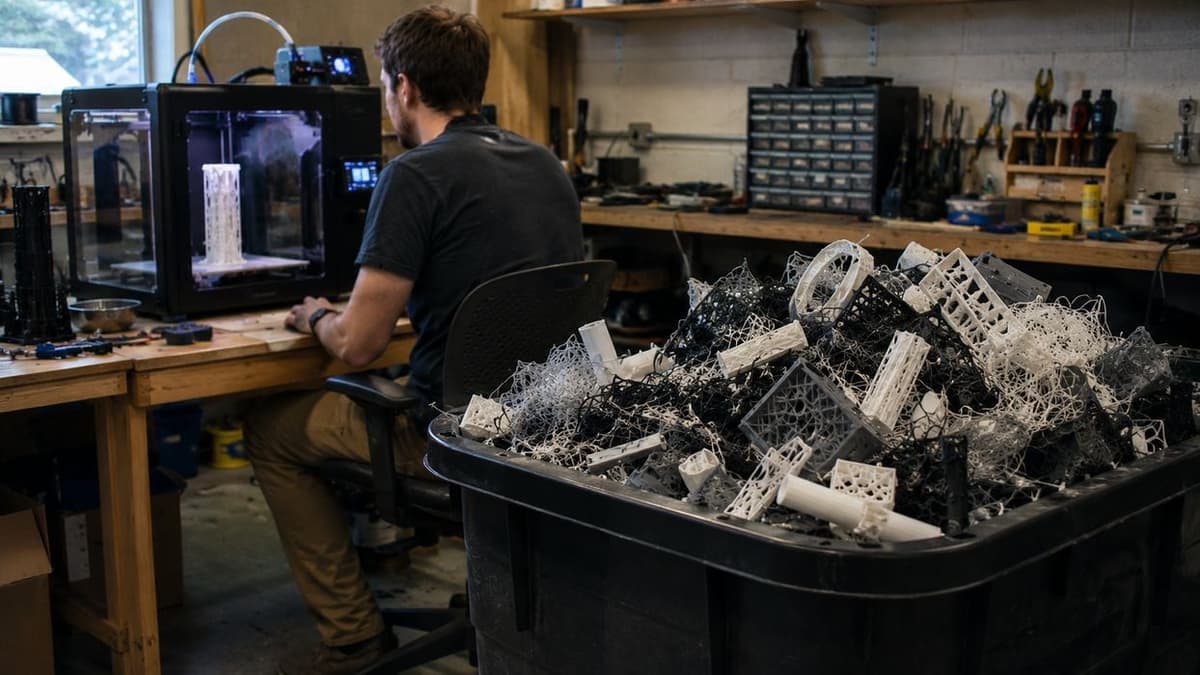
Additive manufacturing, despite its ‘additive’ label, produces a surprisingly diverse waste portfolio. Fused filament fabrication creates purge towers, brims, rafts, failed parts, and leftover filament spools; resin printers leave behind uncured resin, support lattices, and contaminated vats; powder‑bed systems generate excess powder and failed builds. While many operators focus on local disposal or recycling, each gram eventually fragments into microplastics that can enter air, water, and soil. With an estimated tens of millions of desktop and industrial printers in schools, makerspaces, and enterprises, the cumulative waste stream is sizable and growing.
The emerging climate link is likely to shift waste reduction from a peripheral sustainability checkbox to a core performance metric. Equipment manufacturers may prioritize low‑purge, support‑free designs, while material suppliers could develop formulations that degrade into less climate‑active particles. Procurement teams are expected to ask quantifiable questions about scrap per part and end‑of‑life handling, mirroring cost‑of‑ownership analyses. In the longer term, standards bodies might embed microplastic emissions into certification schemes, and regulators could impose reporting requirements, driving the industry toward cleaner, more climate‑aware additive manufacturing practices.
Microplastics May Be an Even Bigger Problem Than We Thought
Comments
Want to join the conversation?