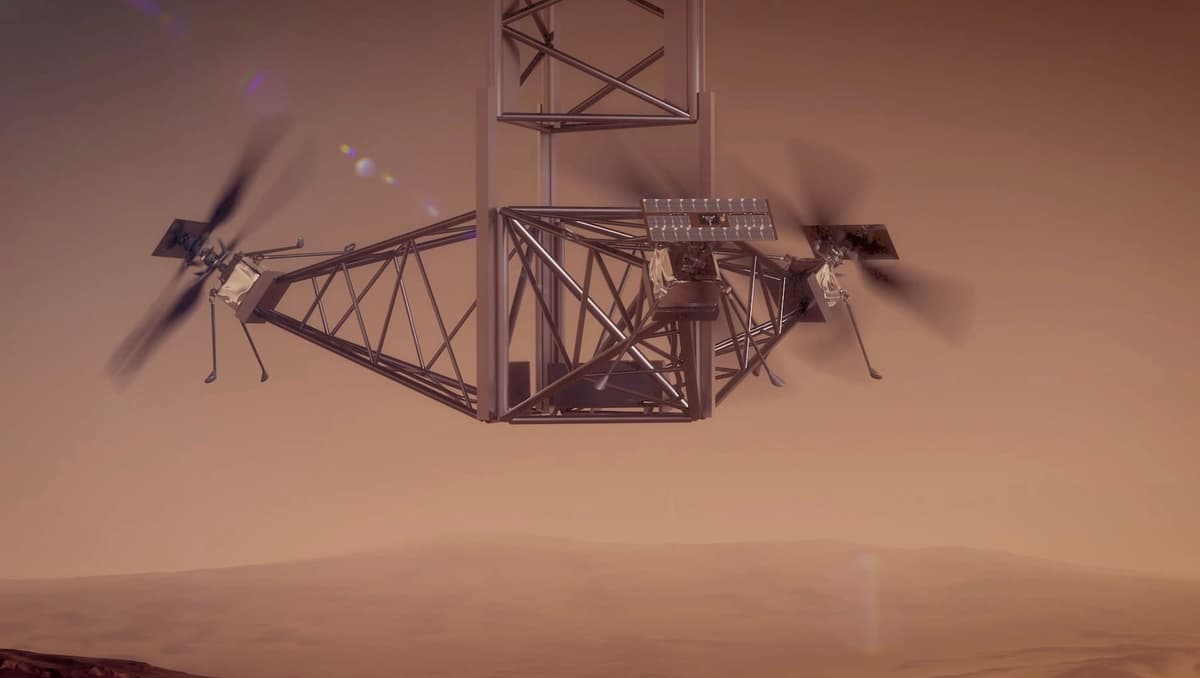
NASA Testing Supersonic Rotors for Mars
Key Takeaways
- •SkyFall rotors reached Mach 1.08 in simulated Martian conditions.
- •Supersonic tip speeds boost lift in 1%‑density Martian atmosphere.
- •Higher rotor loads could double Ingenuity’s payload capacity.
- •Tests validate materials against extreme aerodynamic stresses.
- •Success paves way for heavier science payloads on future missions.
Pulse Analysis
The Ingenuity helicopter proved that powered flight is possible on another world, but its 1.8‑kilogram frame and sub‑sonic rotors limited payload to a few grams of scientific instruments. Mars’ atmosphere, roughly one‑hundredth the density of Earth’s, forces rotor blades to spin far faster than on Earth to generate lift. Engineers therefore face a trade‑off between blade size, speed, and structural integrity, a balance that defined Ingenuity’s modest capabilities.
In a recent series of tests inside a vacuum chamber that replicates Martian pressure and temperature, NASA’s team pushed the new SkyFall rotor tips to Mach 1.08, crossing the sound barrier for the first time in a planetary‑flight context. Achieving supersonic tip speeds required advanced composite materials and precision‑balanced hubs to withstand the dramatic increase in centrifugal forces and acoustic loading. The tests confirmed that the blades can survive these stresses while delivering the thrust needed to lift payloads potentially twice as heavy as Ingenuity’s, opening the door to more ambitious scientific missions.
The implications extend beyond a single helicopter. A heavier, faster‑spinning rotorcraft could transport sample‑return containers, deploy larger sensor suites, or even serve as a scouting platform for crewed landings. Moreover, the technology may spin off into Earth‑based applications such as high‑altitude drones and ultra‑light aircraft. As NASA plans the next wave of Mars exploration, supersonic rotors position SkyFall as a pivotal step toward a more capable, versatile aerial presence on the Red Planet.
NASA Testing Supersonic Rotors for Mars
Comments
Want to join the conversation?