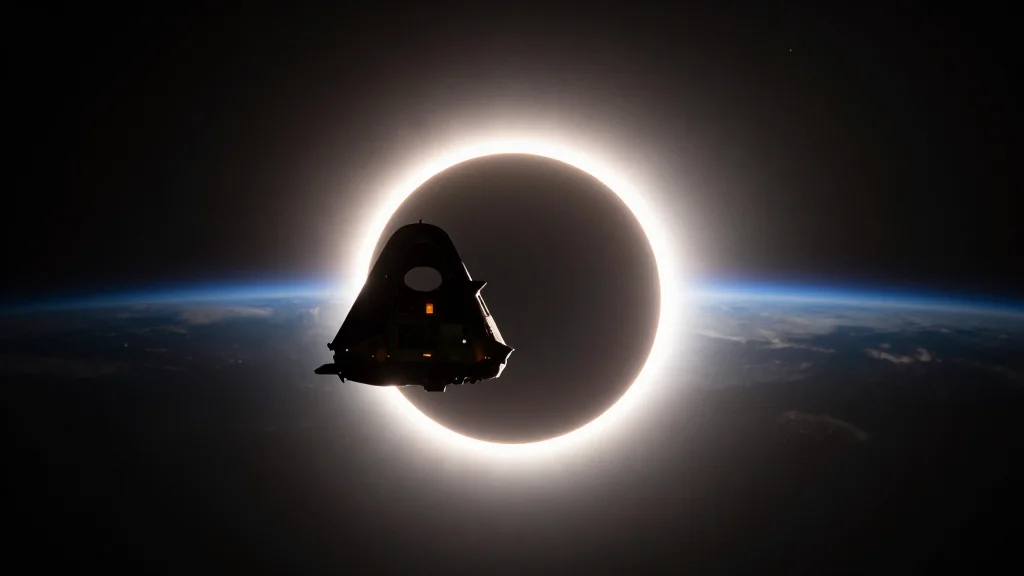
NASA’s Artemis II Crew Experience Total Solar Eclipse From Space
Why It Matters
The extended eclipse offers unprecedented scientific insight into the solar corona, dust dynamics, and Earth‑Moon illumination, informing models that protect astronauts and equipment on upcoming lunar missions. It also showcases Artemis II’s capability to conduct complex observations beyond Earth orbit.
Key Takeaways
- •Artemis II observed 57‑minute total solar eclipse from Orion.
- •Eclipse offered unique view of solar corona and earthshine.
- •Crew searched for lunar dust and zodiacal light.
- •Observations may inform future lunar surface safety.
- •No comet sighting; mission still gathered valuable data.
Pulse Analysis
The Artemis II flight marks the first crewed deep‑space mission to capture a total solar eclipse from the Moon’s vicinity, turning a spectacular celestial event into a scientific laboratory. While the spacecraft circled the lunar far side, the Sun was completely obscured for nearly an hour, allowing the crew to record the Sun’s faint corona, a region that drives space‑weather storms affecting satellite operations and power grids on Earth. By extending totality far beyond the few minutes typical on Earth, NASA gained a prolonged window to study coronal streamers, plumes, and magnetic field structures with onboard cameras and spectrometers.
Beyond solar physics, the eclipse provided a rare platform to investigate dust environments that could jeopardize future lunar habitats. Astronauts looked for levitated lunar regolith particles, whose electrostatic charging can coat equipment, and for zodiacal light caused by interplanetary dust scattering sunlight. Detecting Earthshine on the Moon’s dark side also helped refine models of Earth’s albedo, a key factor in climate monitoring. Simultaneously, the crew photographed Venus, Mars, Saturn and Mercury, and logged micrometeoroid impacts, enriching datasets that support navigation and hazard assessment for upcoming Artemis landings.
The observations have practical implications for the Artemis program’s next phases, where crews will land on the lunar surface and establish a sustainable presence. Understanding how solar radiation, dust, and micrometeoroid fluxes behave in the Moon’s orbit informs the design of habitats, EVA suits, and surface instruments. Moreover, the public’s fascination with a space‑borne eclipse underscores the outreach value of Artemis, reinforcing NASA’s leadership in both exploration and scientific discovery.
NASA’s Artemis II crew experience total solar eclipse from space
Comments
Want to join the conversation?
Loading comments...