NTU 3D Prints Self-Sensing Soft Continuum Robot
Key Takeaways
- •3D‑printed sacrificial molds create embedded sensor lattice
- •Graphite‑PDMS composite provides distributed piezoresistive feedback
- •Conformer model yields 3.8 mm tip‑position error
- •Gripper variant classifies object shapes with 85 % accuracy
- •Stiffness gradient improves stability while maintaining compliance
Pulse Analysis
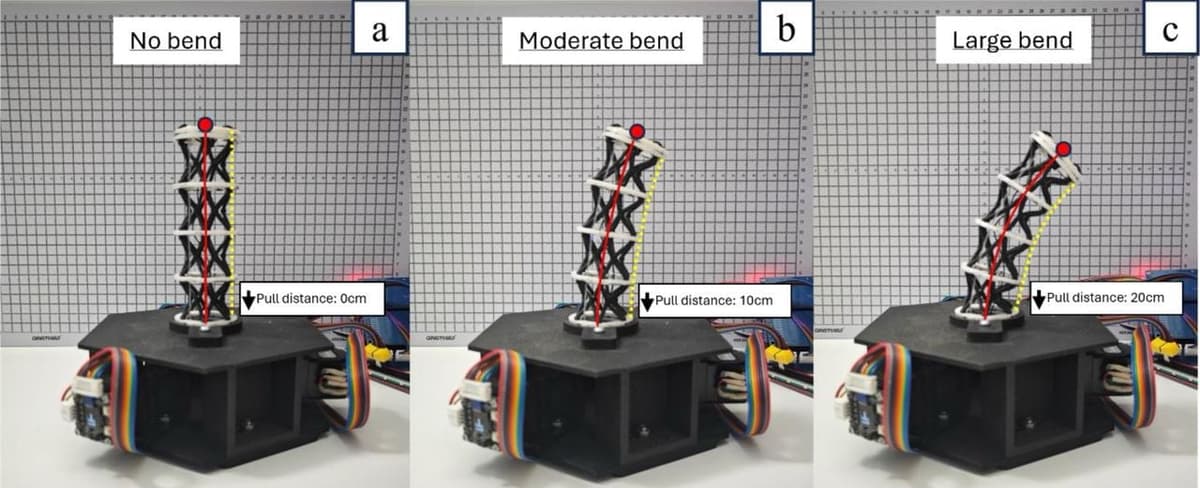
Continuum robots—devices that bend smoothly like an elephant trunk or an endoscope—have long promised new capabilities in minimally invasive surgery, inspection of confined spaces, and delicate manipulation. Yet their adoption has been hampered by the lack of reliable shape feedback, because traditional rigid sensors add bulk and complexity. Researchers at Nanyang Technological University (NTU) have tackled this bottleneck by integrating sensing directly into the robot’s structure. Using 3‑D‑printed sacrificial polyvinyl‑alcohol molds, they cast a graphite‑filled PDMS lattice that doubles as a distributed resistive sensor network.
The resulting cylindrical mesh consists of twelve conductive polymer composite (CPC) struts per segment, each wired to copper mesh electrodes and sampled at 100 Hz. By feeding the six resistance channels together with tendon displacement data into a Conformer architecture—a hybrid of convolutional and Transformer layers—the system learns to map raw signals to curvature and tip position. In tests the robot achieved a mean tip‑position error of 3.8 mm and an end‑effector RMSE of 6.3 mm, even under external disturbances that defeat pure kinematic models. A six‑segment gripper variant also identified object geometry with 85 % accuracy using only the same resistance time‑series.
This integration of additive manufacturing, conductive composites, and data‑driven inference could reshape the soft‑robotics supply chain. By eliminating post‑assembly sensor placement, manufacturers can lower bill‑of‑materials costs, reduce assembly time, and improve durability in harsh environments. The approach is especially attractive for medical manipulators, where sterility and compactness are paramount, as well as for autonomous inspection tools that must operate without visual cues. As machine‑learning models become more robust, we can expect self‑sensing soft robots to move from laboratory prototypes toward commercial platforms in surgery, aerospace, and beyond.
NTU 3D Prints Self-Sensing Soft Continuum Robot
Comments
Want to join the conversation?