Key Takeaways
- •Study uses high‑resolution CFD to simulate dolphin tail flow
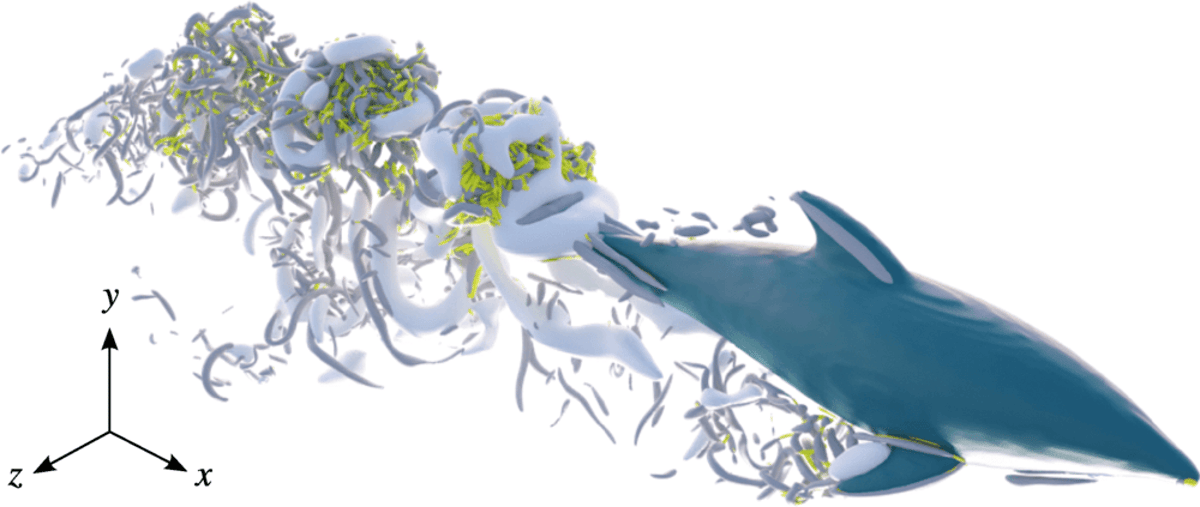
- •Large vortex rings generate most thrust; small vortices negligible
- •Findings enable simplified models focusing on large‑scale structures
- •Potential to inform bio‑inspired propulsion systems for underwater vehicles
- •Simulations captured only fraction of dolphin Reynolds number
Pulse Analysis
Dolphins have long fascinated engineers and biologists because of their remarkable speed and agility. Recent advances in computational fluid dynamics (CFD) now allow researchers to capture the chaotic, high‑Reynolds‑number flow around a swimming dolphin with unprecedented detail. By resolving both the dominant vortex rings shed from the caudal fin and the subsequent cascade of smaller eddies, the study bridges a gap between laboratory‑scale experiments and real‑world marine locomotion, offering a clearer picture of how nature harnesses turbulence for propulsion.
The simulation shows that the bulk of propulsive force originates from large vortex rings that detach from the upper and lower surfaces of the tail during each kick. These coherent structures act like miniature jet engines, pushing water backward and propelling the animal forward. In contrast, the myriad smaller vortices generated downstream have negligible thrust contribution, behaving more like dissipative turbulence. Although the model only reaches a fraction of the dolphin’s actual Reynolds number, the clear separation of scales suggests that future models can safely ignore the fine‑scale turbulence without sacrificing accuracy, dramatically reducing computational cost.
These findings have immediate relevance for bio‑inspired engineering. Designers of autonomous underwater vehicles (AUVs) and robotic fish can now prioritize generating controlled vortex rings rather than replicating the full turbulent spectrum of a real animal. Such a focus promises lighter, more efficient propulsion mechanisms and could accelerate the development of stealthy, high‑speed marine platforms. Moreover, the research opens pathways for cross‑disciplinary collaboration, where marine biologists, fluid dynamicists, and robotics engineers jointly refine simplified yet powerful models of turbulent swimming.
On Dolphin Turbulence
Comments
Want to join the conversation?